
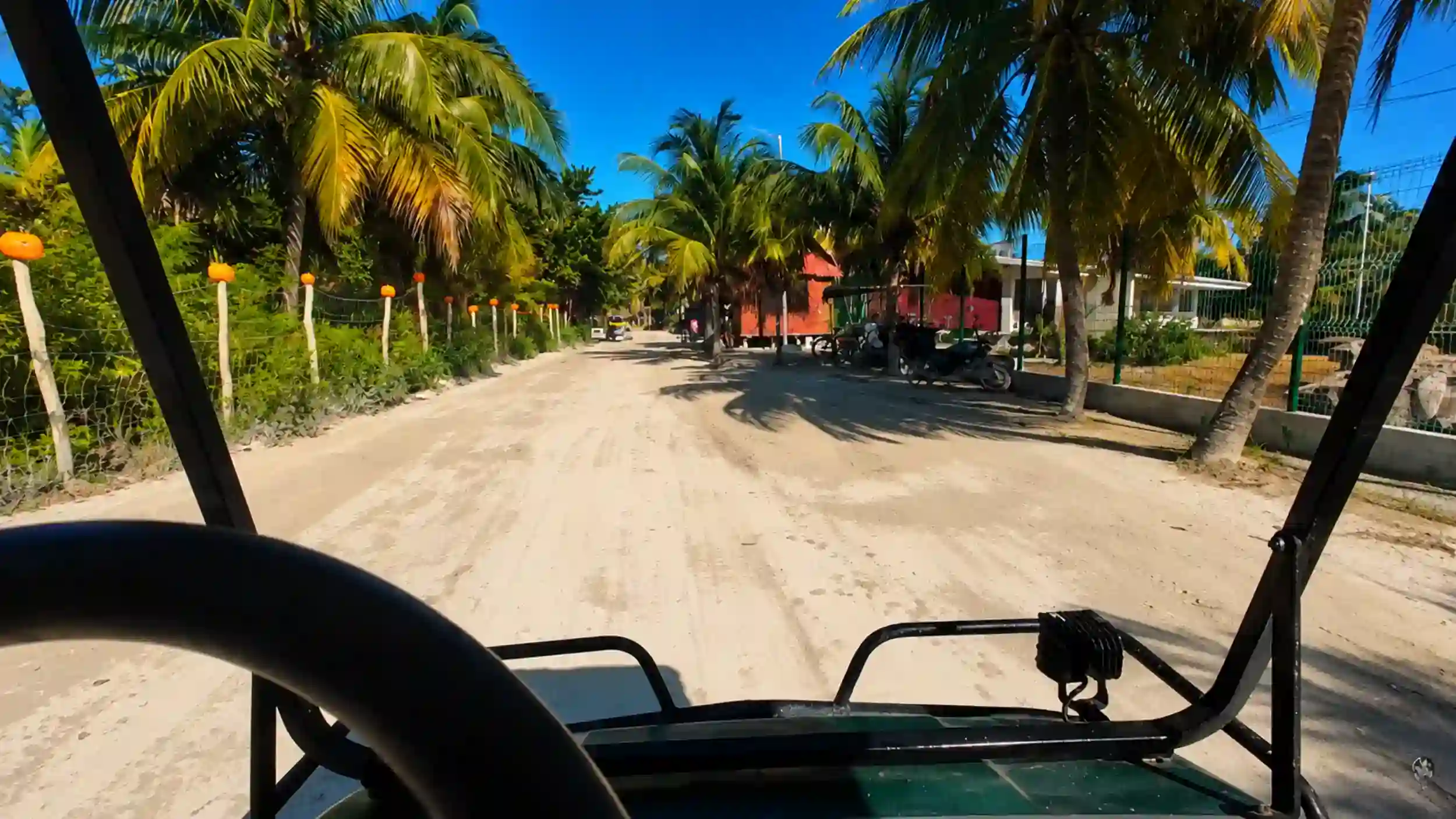
Getting around Holbox is usually easiest on foot, with bicycles useful for longer beach runs and golf-cart taxis filling the gaps. Where you stay matters enormously: central Holbox is highly walkable, while accommodation farther east or west makes bikes and taxis much more useful.
Rain changes everything. A route that feels effortless on a dry sandy road can become awkward after heavy rain.
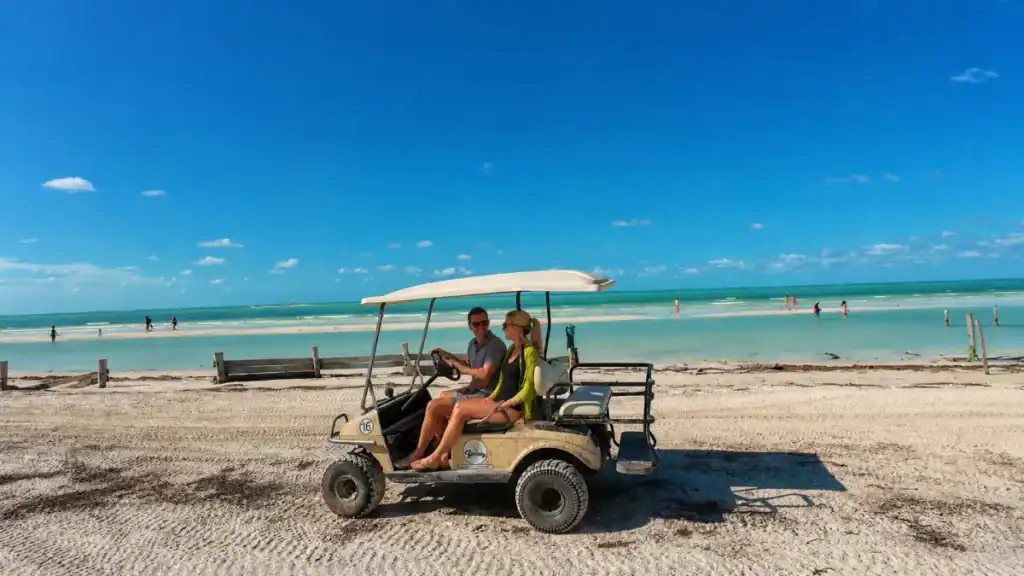
🚶 How do you get around Holbox?
Holbox has an unusual transport mix.
There is no conventional holiday routine of rental car, parking and driving between attractions. Instead, most visitors combine walking, bicycles and golf-cart taxis.
Golf carts can also be rented, but that doesn’t automatically make one the best choice.
Pick the simplest option
| You need to… | Best starting point | Why |
|---|---|---|
| 🍹 Explore central Holbox | Walk | Usually easiest |
| 🏖️ Cover more beach | Bike | Faster without much hassle |
| 🧳 Move with luggage | Golf-cart taxi | Much easier |
| 🌅 Reach farther west | Bike or taxi | Distance starts to matter |
| 🌿 Stay farther east | Bike + taxi mix | Less convenient on foot |
| 🌧️ Travel after heavy rain | Taxi | Roads may be awkward |
Most visitors do not need to choose one form of transport for the entire stay.
The best approach is usually a mixture.
👣 How walkable is Holbox?
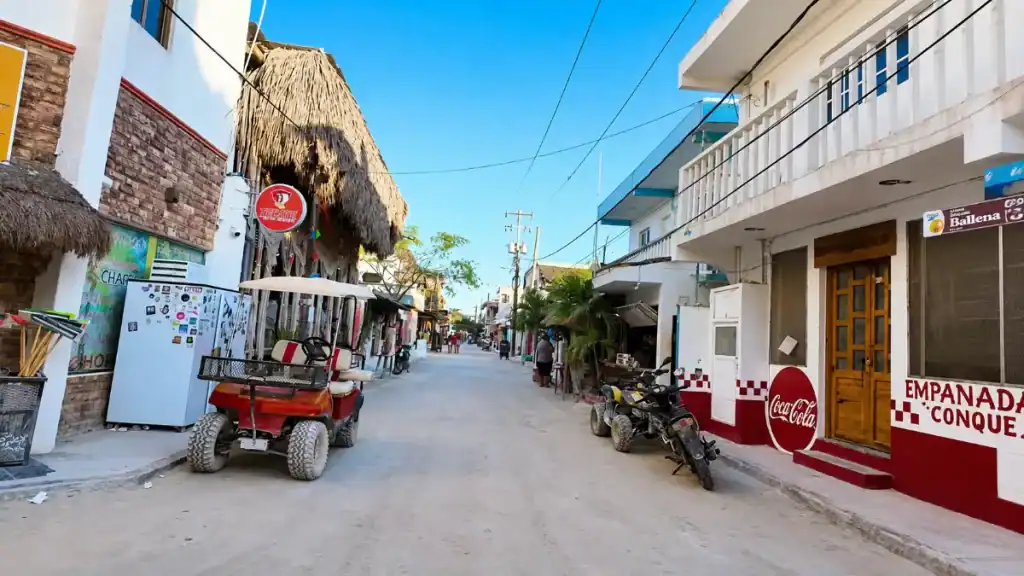
Central Holbox is very walkable.
Restaurants, shops, beach access and much of the town sit close enough together that walking is often quicker than thinking about transport.
If you’re staying centrally or just outside the centre, you may barely use a taxi once you’ve checked in.
Walking also suits the island.
There are no long resort boulevards separating you from everything. You can wander from breakfast to the beach, back through town and out for dinner without planning the journey.
But distance becomes more important as accommodation spreads east and west.
Walking works best when…
- 🏨 You’re staying centrally.
- 🍽️ Most meals will be in town.
- 🏖️ You’re using nearby beaches.
- 🩴 You don’t mind sandy roads.
- 🌤️ Conditions are dry.
Someone staying considerably farther east or west will have a very different experience.
That’s why where to stay in Holbox should be decided alongside transport rather than separately.
🚲 When a bicycle makes sense
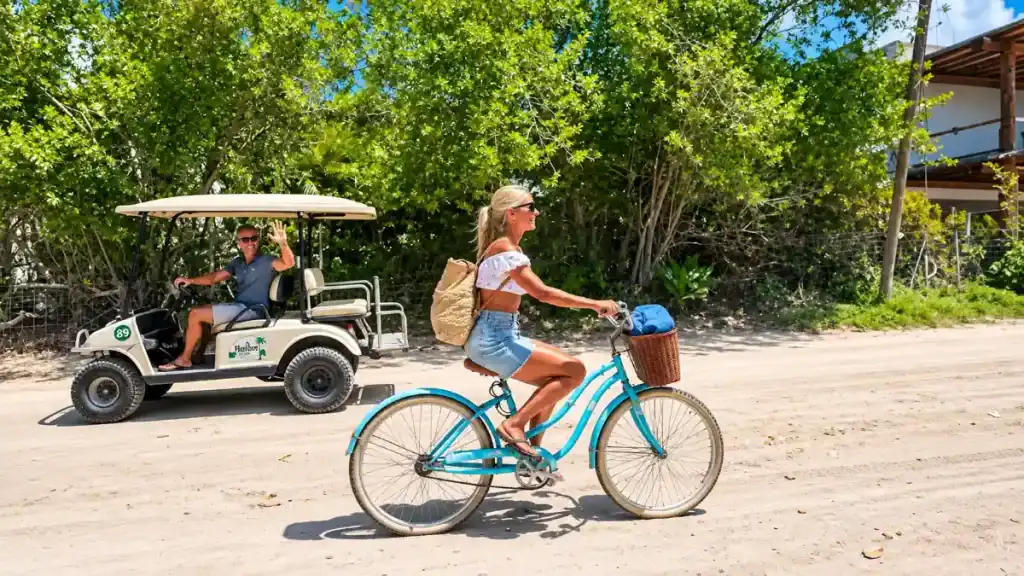
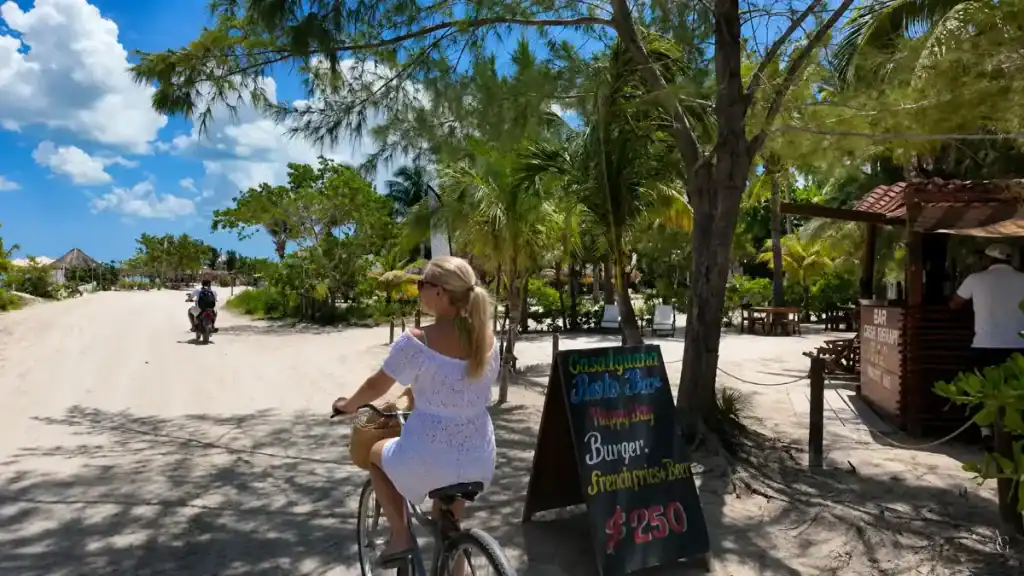
A bicycle is the sweet spot between walking and relying on taxis.
It gives you enough range to explore beyond the central streets without turning every journey into an organised trip.
Bikes are particularly useful if you’re staying slightly outside the centre.
You can cycle into town for food, head farther along the beach and get around independently without renting a golf cart.
Bike wins when…
| Situation | Bike? |
|---|---|
| 🏨 Staying just outside town | Excellent |
| 🏖️ Exploring different beach areas | Excellent |
| ❤️ Couple wanting independence | Very useful |
| 🌅 Heading towards Punta Cocos | Good option |
| 🌧️ Roads badly waterlogged | Much less appealing |
| 🧳 Carrying luggage | Forget it |
The big weakness is obvious.
Holbox roads are sand.
When they’re dry, cycling can be easy enough. After significant rain, conditions may deteriorate and routes can become much less enjoyable.
So a bike is useful freedom.
It isn’t an all-weather solution.
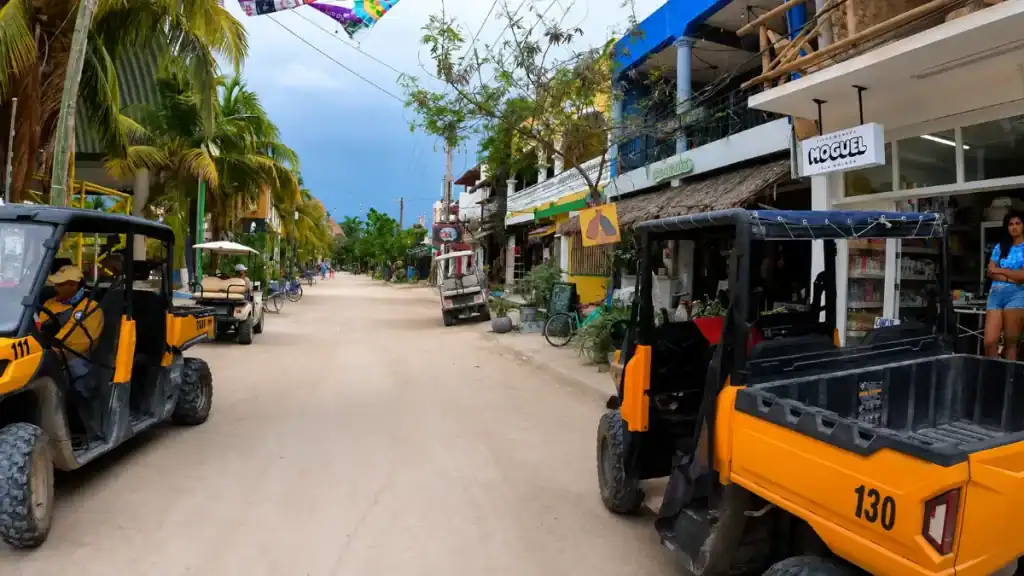
🛺 How golf-cart taxis work
Golf-cart taxis are the island’s practical workhorses.
They are particularly useful when you’ve just arrived with luggage, you’re staying well outside the centre, the weather has turned poor or you’ve simply walked farther than you intended.
You don’t need to use them constantly.
For many visitors they work best as a backup.
Taxi or walk?
| Journey | What usually makes sense |
|---|---|
| 🏘️ Around central town | Walk |
| 🧳 Ferry dock to hotel | Taxi if luggage is awkward |
| 🌅 Centre to farther west | Taxi can save effort |
| 🌿 Farther eastern hotel to dinner | Taxi becomes useful |
| 🌧️ Wet roads | Taxi often wins |
| 🌙 Late evening return | Useful for outer accommodation |
Fares and operating arrangements can change, so current prices should be checked locally rather than relying on an old blog or screenshot.

🔑 Should you rent a golf cart?
Renting a golf cart sounds like the obvious Holbox experience.
Often, it isn’t necessary.
If you’re staying centrally, most of the places you’re likely to use regularly are already within walking distance. A rental can then spend much of the day parked while you pay for the privilege.
It becomes more useful when you want repeated trips between different parts of the developed island or when mobility makes walking and cycling less attractive.
Rent one if…
- 👨👩👧👦 Several people will use it together.
- 🏨 You’re staying away from the centre.
- 🚶 Long walks aren’t practical.
- 🗺️ You expect to make several longer trips.
- ⏱️ Convenience matters more than cost.
Skip it if…
- 👣 You’re central and happy walking.
- 🚲 A bicycle covers your needs.
- 🍹 You’ll spend most of the day around town and the beach.
- 🌿 You’re assuming a cart gives unrestricted access everywhere.
That final point matters particularly around protected natural areas.
A rental golf cart does not turn the island into an unrestricted driving circuit.
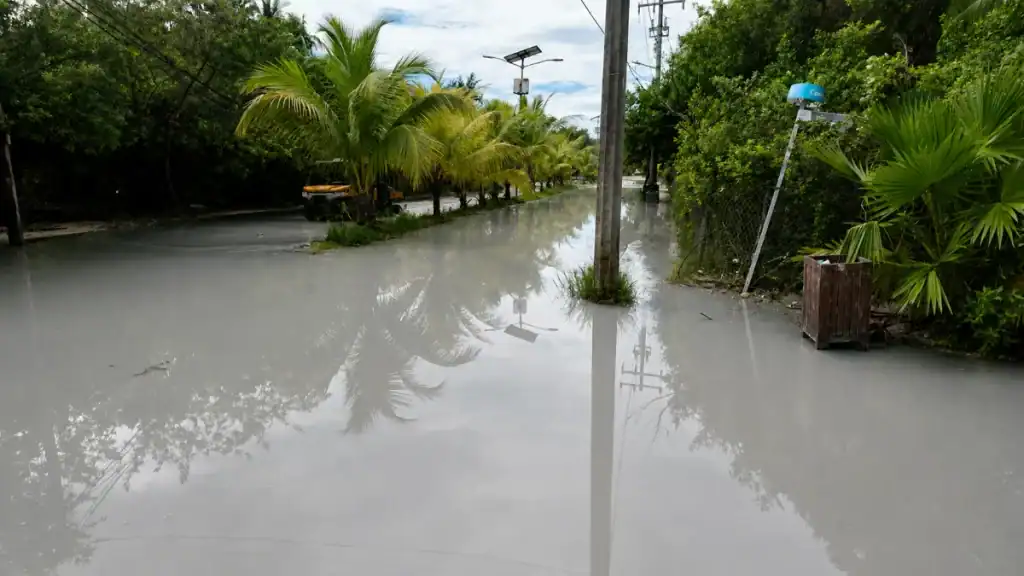
🌧️ How rain changes getting around Holbox
Rain can completely reorder the transport hierarchy.
On a dry day:
Walk → Bike → Taxi
After heavy rain:
Taxi → Walk where practical → Bike
Unpaved roads can collect standing water, and routes that seemed straightforward when you booked accommodation may become much less pleasant.
Rainy-day reality
| Transport | Dry conditions | After heavy rain |
|---|---|---|
| 👣 Walking | Easy centrally | Can become awkward |
| 🚲 Bicycle | Very useful | Can be frustrating |
| 🛺 Taxi | Convenient | Often the best option |
| 🔑 Rental cart | Flexible | Still road-condition dependent |
Rain is also one reason to think carefully before booking accommodation purely because it looks wonderfully remote.
Distance matters much more when the roads are difficult.
Our best time to visit Holbox guide looks at how rainfall changes the wider holiday experience.
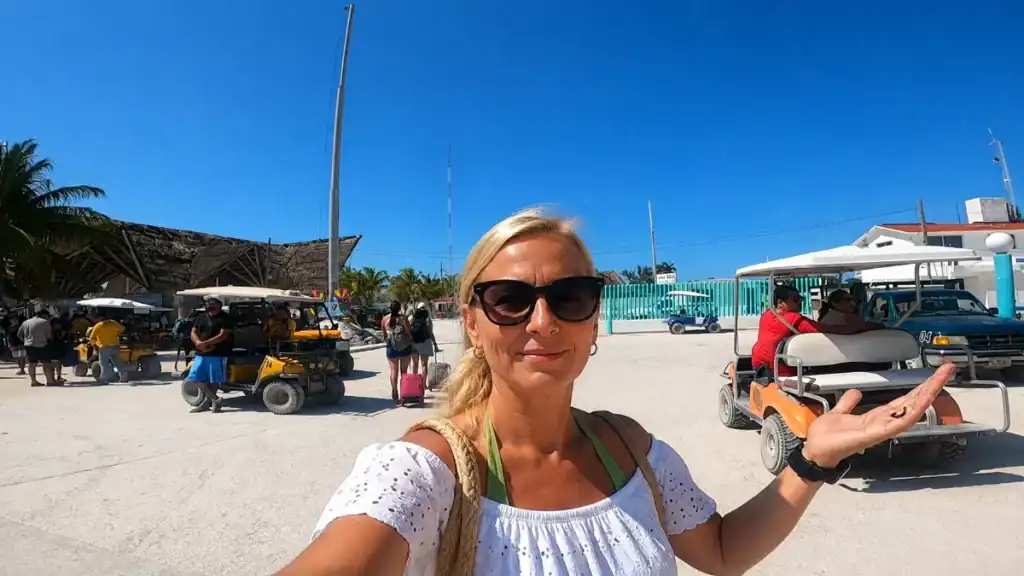
⛴️ Getting from the ferry dock to your hotel
This is the first time most visitors actually need local transport.
If you’re staying nearby and travelling light, walking may be perfectly reasonable.
If you have suitcases, children or accommodation farther east or west, a golf-cart taxi is usually the less heroic option.
Remember that arriving at the Holbox dock is not necessarily the end of the journey.
Your full transfer is:
Cancún → Chiquilá → ferry → Holbox dock → hotel
That final stage is easy to underestimate when planning how to get to Holbox from Cancun.
If you’ve chosen a remote-feeling hotel, expect the last part of the journey to take more effort than a central stay.
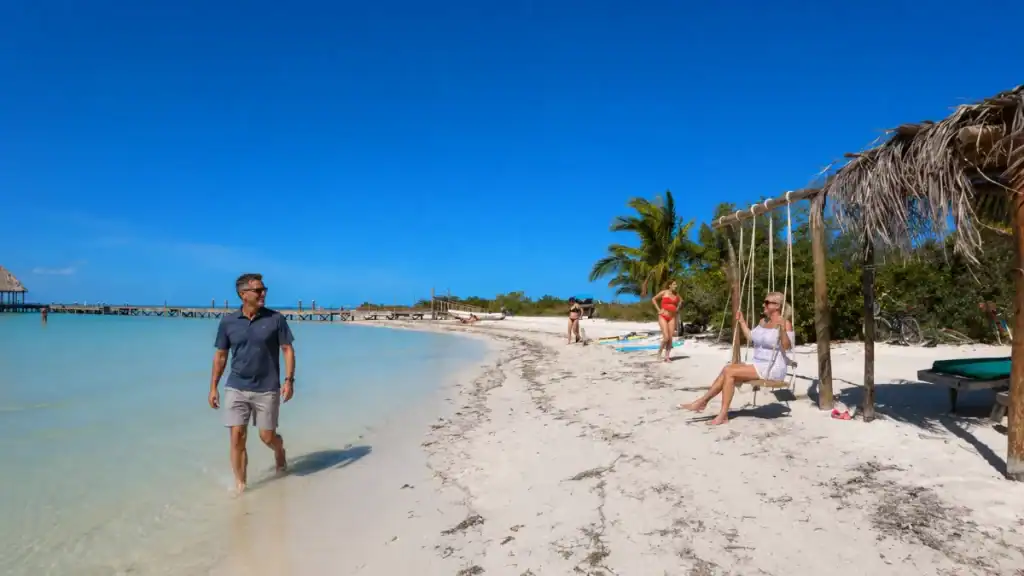
🌅 Reaching Punta Cocos
Punta Cocos lies towards the quieter western side of Holbox.
Walking can be enjoyable if you’re already based west of the centre and you’re treating the journey as part of the day.
From central Holbox, a bicycle can make the trip much easier.
A golf-cart taxi is the more comfortable choice if heat, luggage, children or mobility make the journey itself unappealing.
Punta Cocos transport
| Starting point | Best fit |
|---|---|
| 🏨 Staying west | Walk or bike |
| 🏘️ Central Holbox | Bike or taxi |
| ❤️ Slow beach day | Bike can be ideal |
| 🌙 Returning after sunset | Taxi may be easiest |
| 🌧️ Poor road conditions | Taxi |
Don’t overthink it.
Punta Cocos is somewhere you can incorporate naturally into a Holbox stay rather than an expedition requiring a transport strategy.
🌿 Reaching Punta Mosquito
Punta Mosquito needs more care.
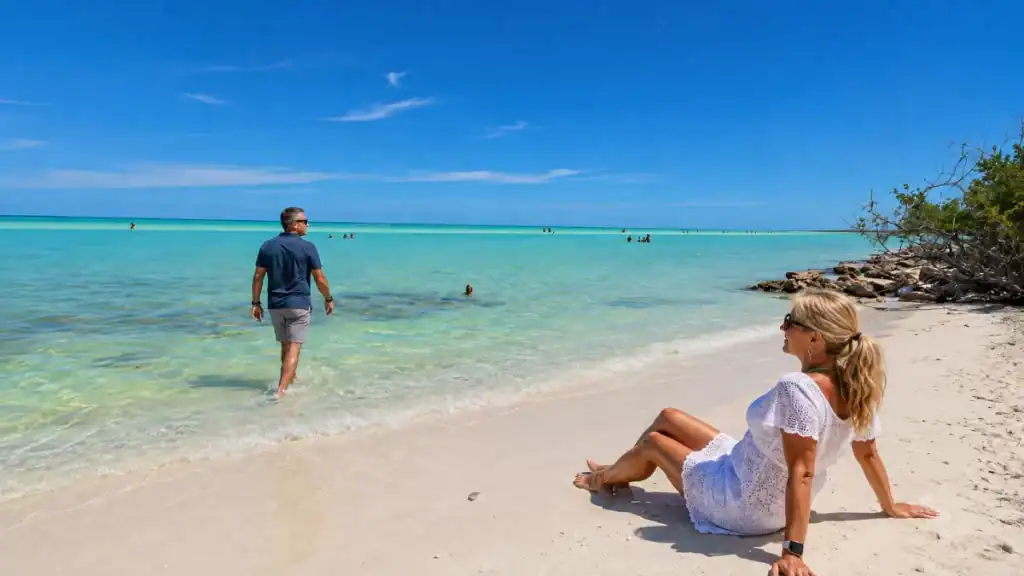
The eastern side becomes increasingly natural, and access should not be treated as though you can simply drive a golf cart to whichever point you choose.
Golf carts can only take you so far in the direction of the protected area. Depending on current access arrangements and conditions, reaching the area you want to explore may involve a substantial walk.
That can include beach or shallow-water walking rather than conventional road access.
Don’t make this assumption
Golf-cart rental = drive directly to Punta Mosquito
It doesn’t.
Protected-area restrictions and access conditions can change, so check current local guidance before setting out.
The important planning point is simple: allow for walking.
If mobility is limited, don’t choose Punta Mosquito as an activity based purely on how close it appears on a map.
🧭 Best transport by traveller type and location
The easiest way to solve getting around Holbox is to start with where you’re sleeping.
Where you stay changes everything
| You’re staying… | Main transport | Backup |
|---|---|---|
| 🍹 Central Holbox | Walk | Taxi |
| ⚖️ Just outside centre | Walk + bike | Taxi |
| 🌿 Farther east | Bike | Taxi |
| 🌅 Farther west | Bike | Taxi |
| 🏖️ Remote beachfront stay | Stay local + taxi when needed | Bike |
| 🌧️ During poor road conditions | Taxi | Walking where practical |
Then adjust for the traveller.
Final transport matrix
| Traveller | Best strategy |
|---|---|
| ❤️ Couple staying centrally | Walk almost everywhere |
| 🎒 Independent traveller | Walk + bicycle |
| 👨👩👧👦 Family | Walk + golf-cart taxis |
| 🌿 Nature-focused visitor | Bike + walking |
| ♿ Limited mobility | Golf-cart taxis |
| 🌅 Staying far west | Bike/taxi combination |
| 🌴 Staying far east | Bike/taxi combination |
| 🌧️ Wet-weather visitor | Lean heavily on taxis |
For most people, getting around Holbox does not require renting anything for the entire trip.
Stay centrally and walking may cover nearly everything.
Stay farther east or west and bicycles become much more useful, with golf-cart taxis filling the gaps.
Use taxis for luggage, longer journeys and bad weather.
Rent a golf cart only if your location, mobility or daily plans genuinely justify it.
And don’t assume every sandy track or natural area is open to vehicles simply because golf carts are part of island life.
Holbox is easiest when you use the simplest transport for each journey rather than trying to choose one solution for the whole holiday.