Chania Old Town is best explored by wandering rather than following a fixed route. Its Venetian lanes, Ottoman courtyards, harbour viewpoints and quieter backstreets sit close together, but the experience changes quickly from one street to the next. We found that allowing time for wrong turns revealed far more than trying to navigate it efficiently.
🏛️ Why Chania Old Town Feels So Layered
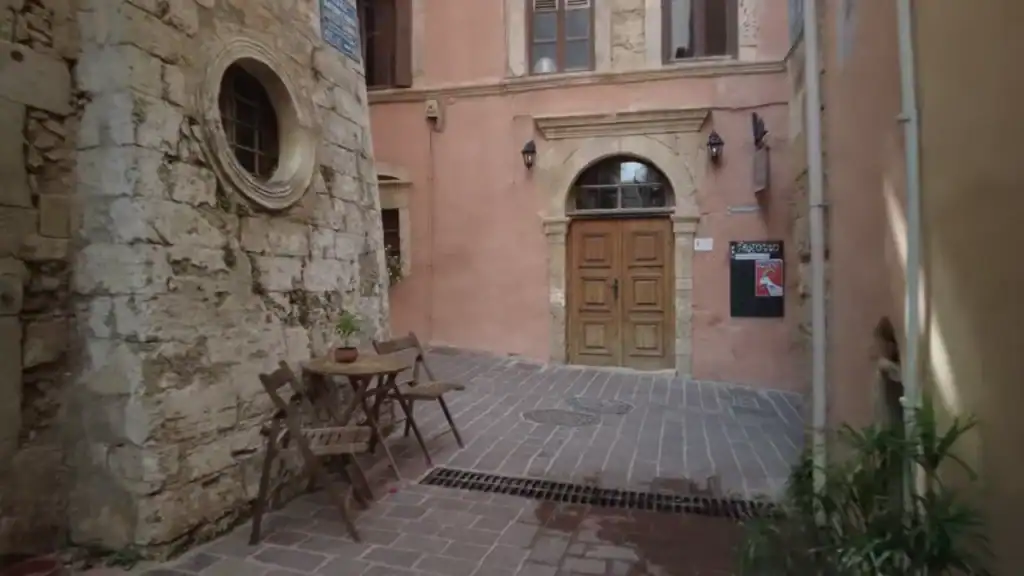
One reason wandering works so well in Chania Old Town is that the history is not confined to individual monuments. Different periods appear almost street by street, so the character of a walk can change within a few minutes.
The layers are particularly easy to notice on foot because later civilisations adapted what was already there rather than simply replacing it.
The Venetians shaped the harbour, defensive walls and street layout. The Ottomans added mosques, hammams and courtyards, while later generations adapted many of those buildings for modern life. The result is a town where centuries of history sit side by side within a remarkably compact area.
How Chania Old Town’s History Reveals Itself on Foot
We found the layout made more sense once we stopped trying to make it fit the map.
Narrow lanes branch unexpectedly, small squares appear without warning and streets rarely follow the straight lines a modern town would encourage. That unpredictability is useful rather than inconvenient: it constantly exposes another piece of the Old Town’s history.
| Historical layer | What remains today |
|---|---|
| 🏰 Venetian period | Harbour walls, fortifications and elegant stone buildings |
| 🕌 Ottoman period | Mosques, courtyards and distinctive architectural details |
| ⛪ Modern Greece | Restored churches, museums and lively public squares |
| 🚶 Medieval street plan | A maze of pedestrian lanes built long before cars |
For us, that mixture was what made wandering more rewarding than working through a sightseeing list. A minaret, stone doorway or tucked-away courtyard could become the reason to change direction, so the history gradually revealed itself through the walk rather than as a sequence of scheduled stops.

🥐 Where Chania Old Town Feels More Local
By midday, we found Chania Old Town beginning to feel less like a collection of historic streets and more like a working part of the city. The contrast became clearest as we moved away from the harbour towards the market streets.
What I noticed almost immediately was the change in rhythm. The harbour remained busy with visitors, while the streets around the market felt much more connected to everyday life.
We passed local shoppers browsing produce and cafés that felt less dominated by day-trippers. Fresh bread, herbs and olive oil replaced the salty air of the waterfront, even though we had walked only a short distance inland.
What Is Bougatsa Like in Chania?
I would try bougatsa at least once in Chania, particularly because the Cretan version may not be what you expect if you have eaten the pastry elsewhere in Greece.
Unlike the sweet custard version found elsewhere in Greece, the Cretan variation is filled with myzithra cheese and finished with cinnamon and sugar, creating a combination that’s both savoury and subtly sweet.
| Market experience | What to expect |
|---|---|
| 🧀 Local produce | Cheese, olives, herbs and seasonal fruit |
| 🥐 Fresh bougatsa | Warm filo pastry with myzithra cheese |
| ☕ Small cafés | Busy with local customers at lunchtime |
| 🍷 Traditional tavernas | Simple Cretan dishes away from the harbour |
We liked how quickly the atmosphere changed here. The market is only a short walk from the waterfront, yet people are shopping, eating and getting on with everyday routines rather than stopping for harbour photographs. It is a useful reminder that Chania Old Town is not only its Venetian waterfront.
⚓ Why Chania Harbour Changes as You Walk
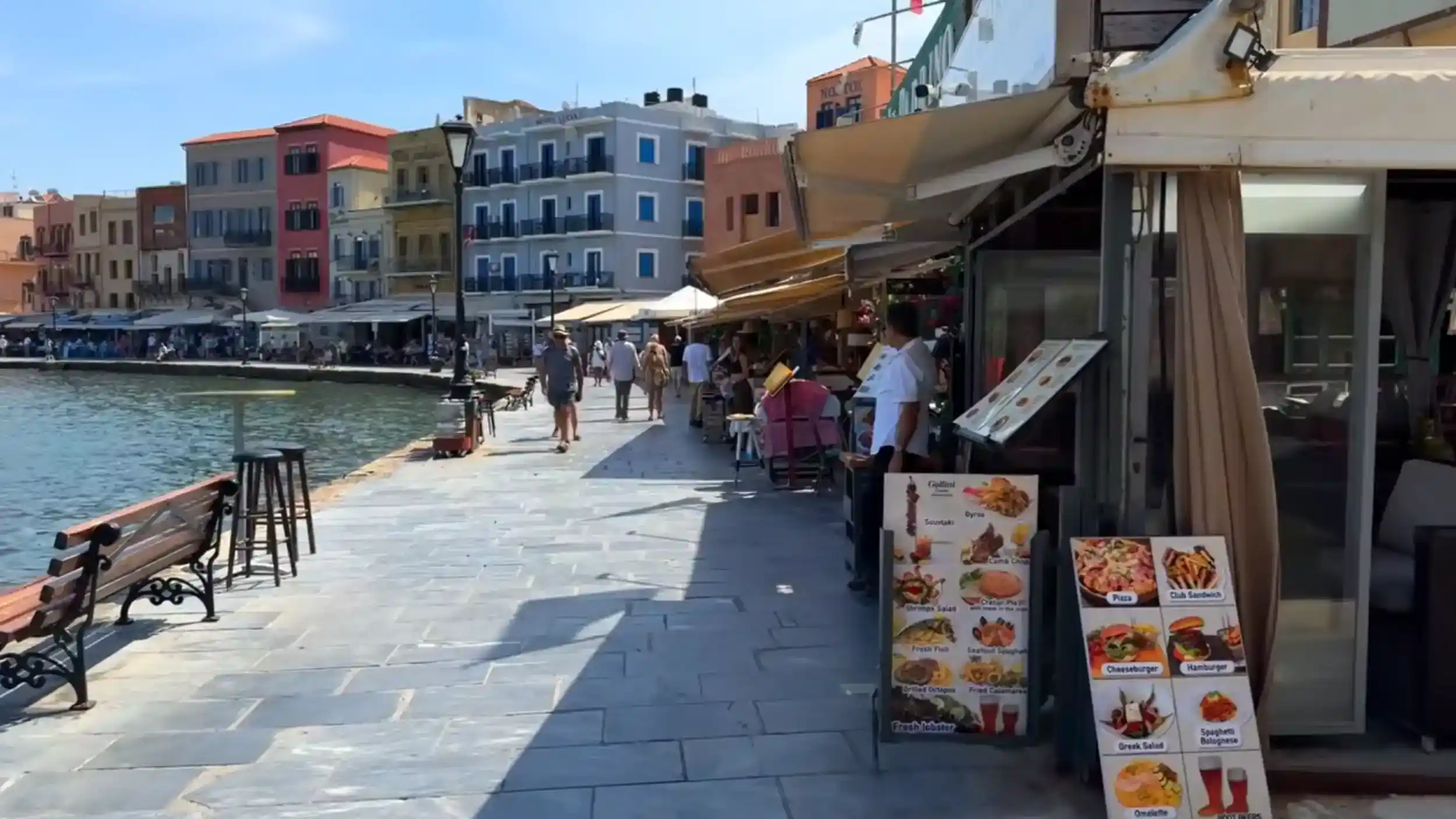
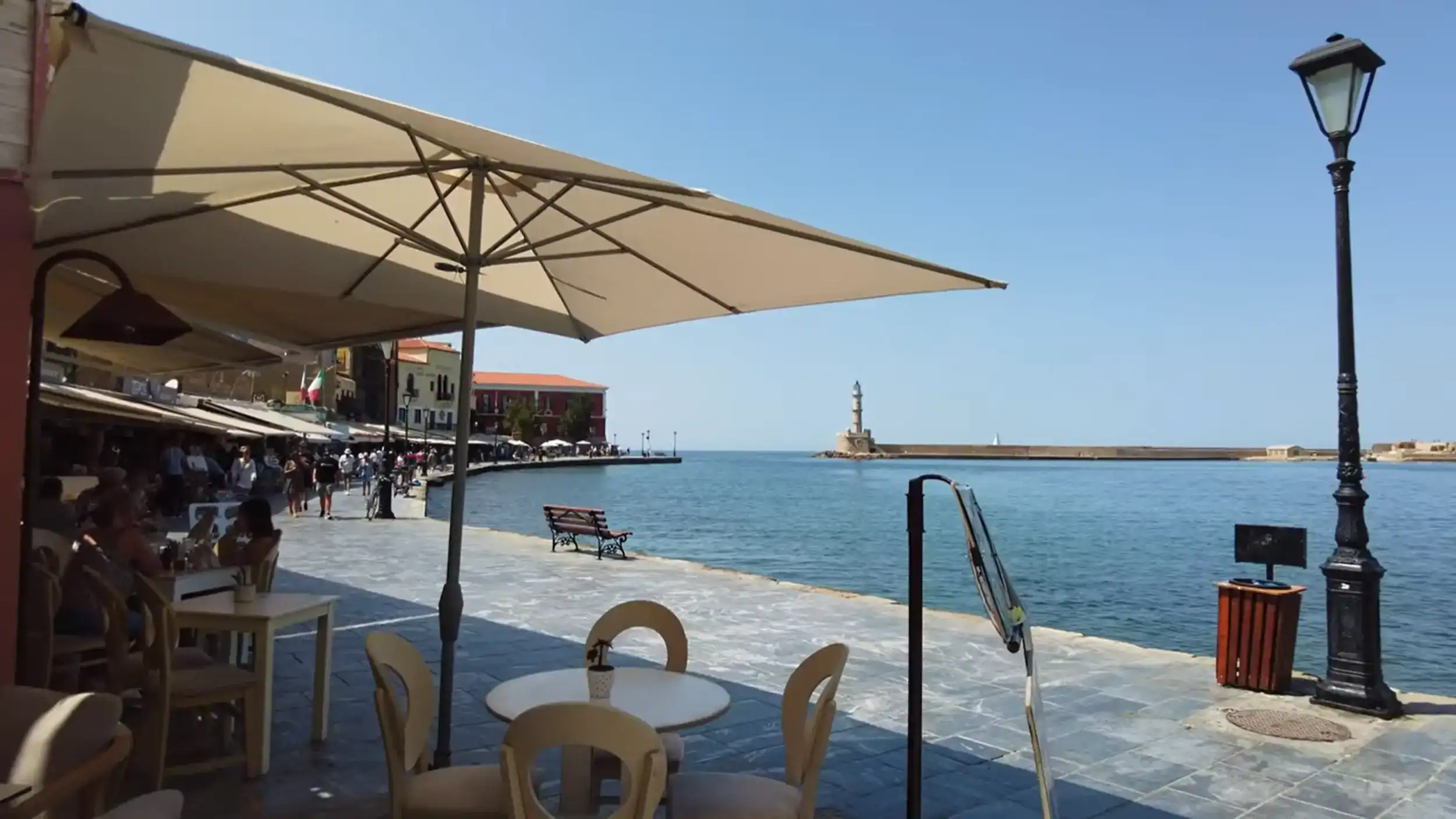
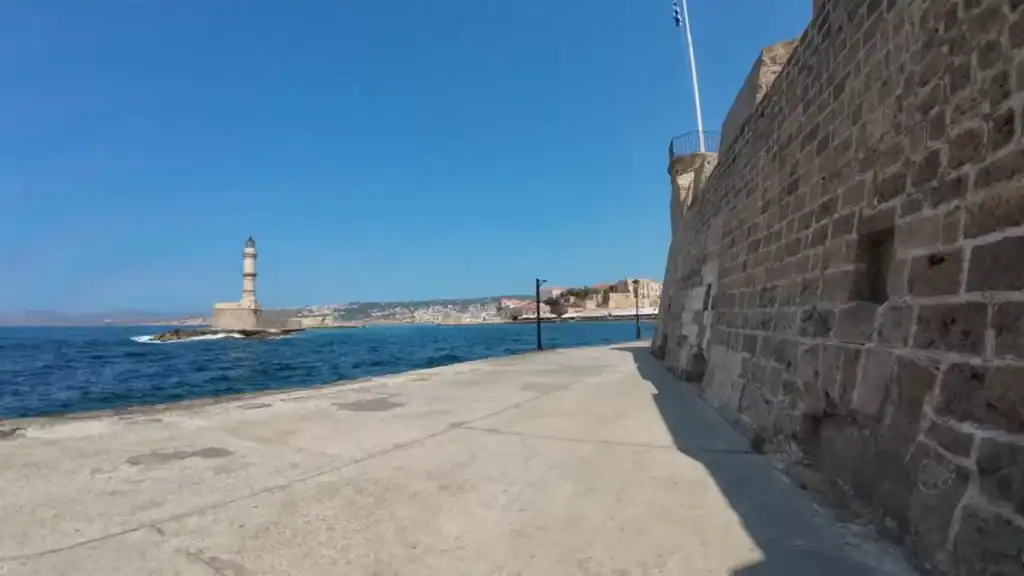
One of the things we enjoyed most about Chania’s harbour was how much the view changed after walking only a few hundred metres.
Beside the cafés, we were looking at the waterfront itself. As we continued towards the lighthouse, the perspective gradually reversed and the Old Town became the view instead.
I thought the harbour became more interesting once we started looking back towards the Old Town rather than simply out across the sea. It is an easy perspective to miss if you stop after walking the waterfront promenade.
Which Chania Harbour Viewpoints Are Worth Walking To?
We found it was worth continuing beyond the obvious waterfront viewpoint rather than treating the promenade as the harbour experience.
| Viewpoint | What you’ll see |
|---|---|
| 🌊 Waterfront promenade | Colourful Venetian buildings and the curved harbour |
| 🚶 Harbour wall | Open sea and the lighthouse drawing closer |
| 🗼 Lighthouse | The Old Town rising in layers behind the waterfront |
| 🏰 Firkas Fortress | A broader view across the harbour entrance |
The lighthouse walk was particularly worthwhile because looking back pulled the separate parts of the harbour together. From there, the waterfront stops feeling like individual façades and starts reading as one connected landscape shaped by centuries of Venetian and Ottoman influence.
The waterfront also changes noticeably with time of day, which is why our guide to Chania harbour visits looks at what you gain by returning rather than seeing it only once.
⛪ Why We Kept Wandering Beyond Chania Harbour
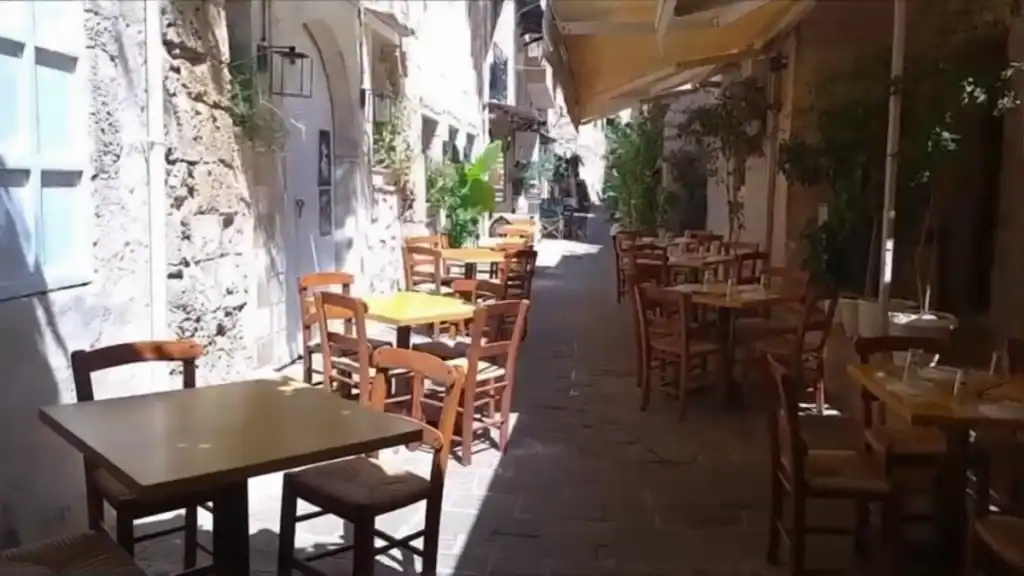
The Jewish Quarter and Splantzia show why it is worth continuing beyond Chania’s waterfront. The change begins almost as soon as you leave the harbour streets.
We noticed the streets becoming quieter, the buildings less polished and the flow of people thinning surprisingly quickly.
For us, these neighbouring districts revealed a slower side of Chania Old Town. History felt woven into ordinary streets and buildings rather than presented as a sequence of landmarks we were expected to visit.
What Will You Find in the Jewish Quarter and Splantzia?
Neither neighbourhood needs a complicated route. Their appeal comes from allowing the smaller streets to lead you between courtyards, cafés and historic buildings.
We found small courtyards and shaded cafés appearing naturally between narrow lanes, with historic details mixed into ordinary streets rather than isolated as formal sights. That makes this part of Chania Old Town particularly rewarding on foot.
| Neighbourhood | Why visit |
|---|---|
| ✡️ Jewish Quarter | Quiet lanes, Etz Hayyim Synagogue and hidden courtyards |
| ⛪ Splantzia | Historic square, cafés and the Church of Agios Nikolaos |
| 🌳 Small squares | Peaceful places to pause away from the harbour |
| 🚶 Narrow alleys | A more authentic side of the Old Town |
Splantzia stayed with me because the city’s layered history was so visible without needing much explanation. At the Church of Agios Nikolaos, the bell tower and minaret sit together in the same view, illustrating the Venetian, Ottoman and Greek influences that shaped Chania. It is exactly the sort of detail we could easily have missed by staying around the harbour.
🍷 Why We Preferred Eating Away from the Waterfront
We found that eating away from Chania Old Town’s waterfront meant giving up the immediate harbour view, but only for a few minutes’ walk.
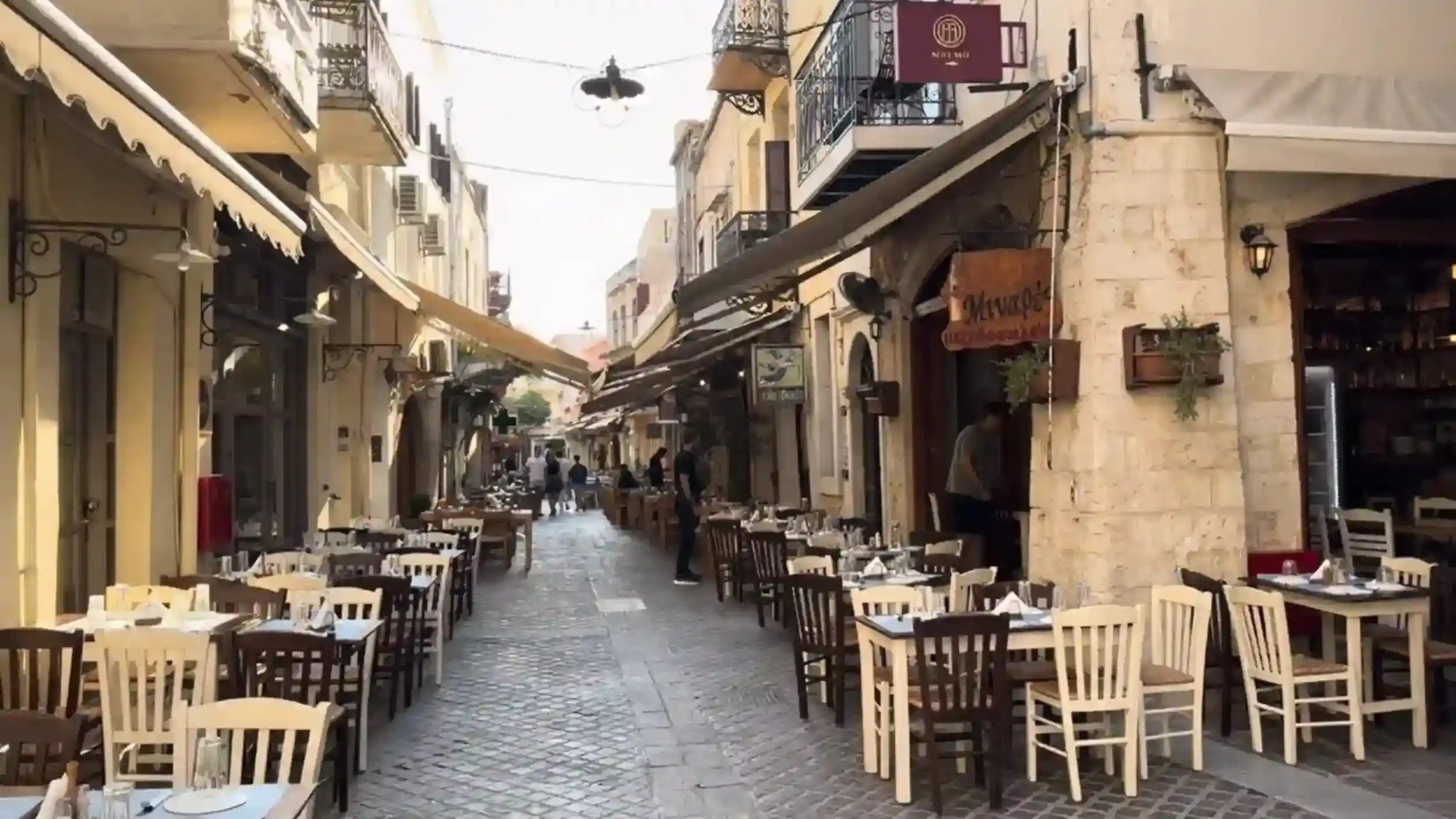
For us, that was an easy trade. The backstreets offered smaller courtyards, quieter tables and a dining atmosphere that felt much less dominated by passing foot traffic.
After walking only two or three minutes inland, we were already seeing quiet courtyards, family-run tavernas and small wine bars instead of the busy restaurants lining the waterfront.
Where Should You Eat Away from Chania’s Harbour?
We found this was another occasion when wandering worked better than treating the Old Town as a list of named stops.
A couple of minutes inland gives you time to read menus and look into courtyards without the constant movement of the promenade. The choice becomes less about securing a harbour-facing table and more about finding a setting that appeals.
| Away from the harbour | What you’ll find |
|---|---|
| 🍽️ Traditional tavernas | Authentic Cretan cooking in quieter settings |
| 🍷 Small wine bars | Local wines and regional cheeses |
| 🌿 Courtyard restaurants | Peaceful dining hidden behind stone walls |
| ☕ Independent cafés | Relaxed places to escape the busiest streets |
I would not claim that every backstreet meal is automatically better. What changed most for us was the setting. With less passing foot traffic, the meal felt calmer and the courtyard or narrow street became part of the reason for choosing the restaurant.
If those quieter streets appeal, Chania beyond the Old Town continues into neighbourhoods, beaches and lesser-known parts of the city outside the historic centre.
🗺️ Why Chania Old Town Works Best on Foot
We never felt we needed a car inside Chania Old Town. Walking was not only the easiest way to get around, but also the reason we noticed many of the lanes, courtyards and small squares that made the historic centre interesting.
Being on foot also meant we could change direction whenever a side street, courtyard or square caught our attention, without worrying about following a planned route.
The narrow lanes, small squares and pedestrian streets were never designed for modern traffic. Once we were inside them, trying to explore any other way would have missed much of what makes Chania Old Town enjoyable.
How Easy Is Chania Old Town to Explore on Foot?
We were surprised by how compact the main sights felt once we started walking. There was no need to organise the day around long transfers between the harbour, market and surrounding neighbourhoods.
That means you can move between the harbour, market, Jewish Quarter and Splantzia without long walks, while still leaving plenty of time to wander into quieter streets along the way.
| Getting around | What to expect |
|---|---|
| 🚶 On foot | The easiest way to explore every neighbourhood |
| 🚌 Bus station | A short walk from the Old Town entrance |
| 🚕 Taxis | Convenient for reaching the airport or ferry port |
| 🚗 Car hire | Useful for exploring western Crete, not the Old Town itself |
The only misleading part is time. We repeatedly found that a short-looking route took longer because another lane or square tempted us away from the direct path. In Chania Old Town, allowing extra wandering time is more useful than trying to calculate walking times too precisely.
Before the walking begins, our guide to getting to Chania covers the practical options for arriving by air, ferry and road.
✨ Why Chania Old Town Rewards a Second Walk
I never felt that Chania Old Town was somewhere we had simply ‘done’ after one walk.
We could locate the main landmarks easily enough, but they were not what kept drawing us back into the streets.
Even after spending hours exploring, we still had the sense that another courtyard, café or lane was sitting just beyond a turn we had not taken.
Is Chania Old Town Worth Exploring More Than Once?
For us, returning worked because attention shifted each time rather than because the landmarks had changed.
We noticed this on streets we had previously used simply to reach the harbour. On another walk, the same route revealed a doorway, courtyard or café we had barely registered before. Morning and evening light also changed which details stood out, giving familiar lanes a noticeably different mood.
| Return visit | What you’ll notice |
|---|---|
| 🏛️ Architecture | New Venetian and Ottoman details in familiar streets |
| ☕ Hidden cafés | Places missed on previous walks |
| 🌅 Changing light | Different moods from morning to evening |
| 🚶 Side streets | New routes leading to quiet squares and courtyards |
That is ultimately why wandering Chania Old Town worked so well for us. The landmarks gave us reference points, but the memorable parts were often what happened between them: a quieter courtyard, a different harbour perspective or a historical detail noticed almost by accident. Once we stopped trying to see everything efficiently, those discoveries became the attraction.
Once the historic centre begins to feel familiar, Chania beyond the Old Town shows how the same exploratory approach can continue into quieter waterfronts and local neighbourhoods.