There’s a moment, somewhere between the third wrong turn and the smell of warm pastry drifting from a bakery you can’t immediately locate, when Chania Old Town stops being a place you’re navigating and starts being a place that’s navigating you. That shift is the whole point.
Streets That Were Never Built for Directions
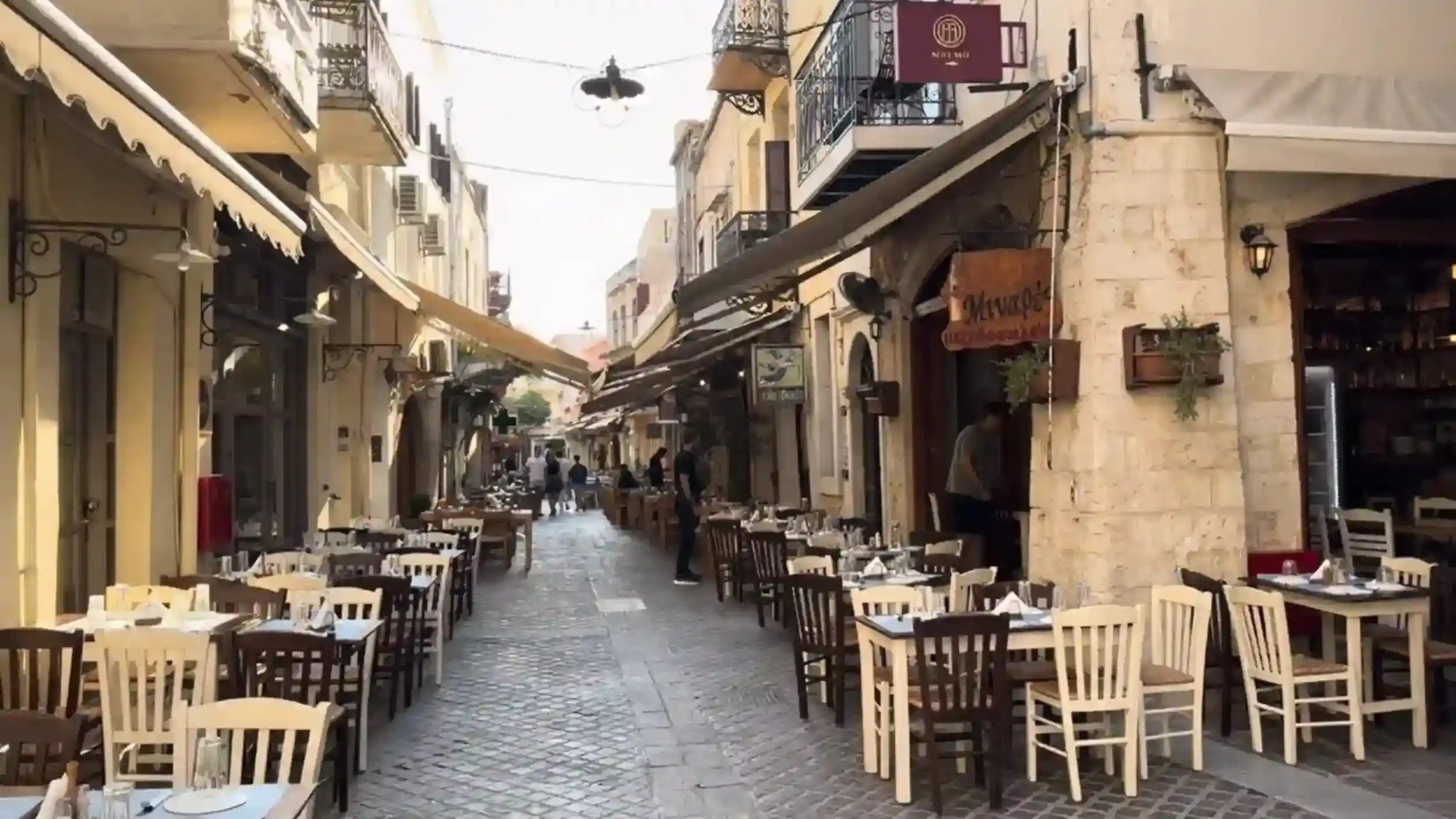
The Ottoman-Venetian street grid – if you can call it a grid – has a logic that doesn’t translate to maps. Lanes narrow without warning. Archways appear in the middle of residential walls. A covered passage you enter from the market side deposits you, unexpectedly, beside a crumbling mosque with cats asleep across its steps. Chania Old Town sits on the northwestern tip of Crete, and within its walls, the accumulated decisions of Venetian merchants, Ottoman administrators, and Cretan families over five centuries have produced something that feels less like urban planning and more like geological sediment. Each layer is visible if you know what to look for – or if you simply slow down enough to notice what doesn’t quite match.
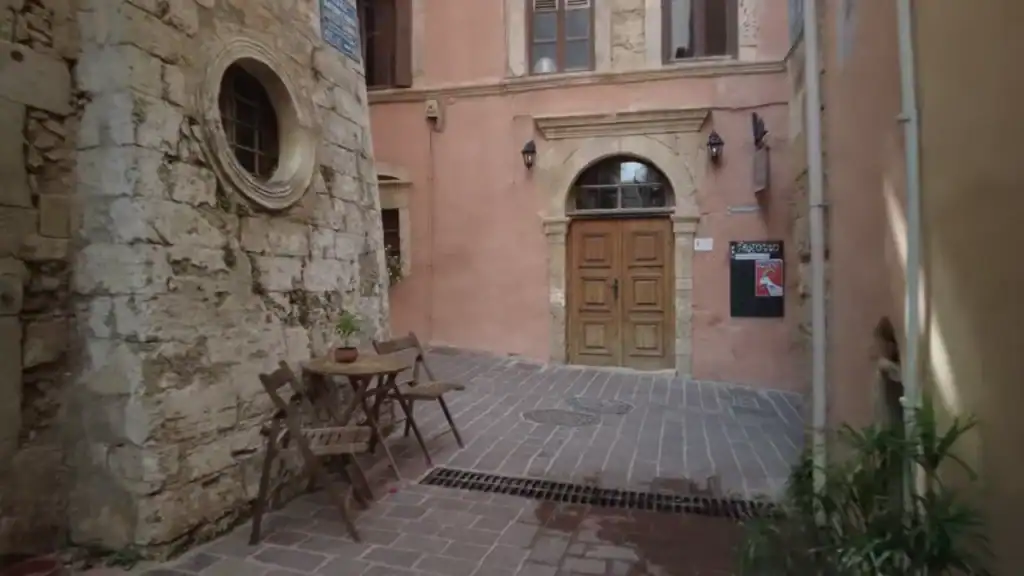
The practical implication? Twenty thousand steps in a single day is not unusual here. It’s almost inevitable.
What the Old Town Smells Like After Siesta
By early afternoon, the market streets near the covered hall settle into quiet. Vendors restack crates. Cafés let chairs scrape back from tables. There’s a faint smell of oregano, dried and sharp, mingled with something yeasty from bakeries that haven’t yet sold out. This is when the bougatsa shops matter. A warm slice of the Cretan version – filo pastry encasing salty cheese, finished with a dusting of cinnamon and sugar you add yourself – confuses expectations in a useful way. It reads as a sweet. It isn’t, quite. The cinnamon bridges the sourness of the myzithra; the sugar doesn’t resolve it, it complicates it. How you react says more about how you travel than anything else.

The Venetian Harbour: Older Than It Looks
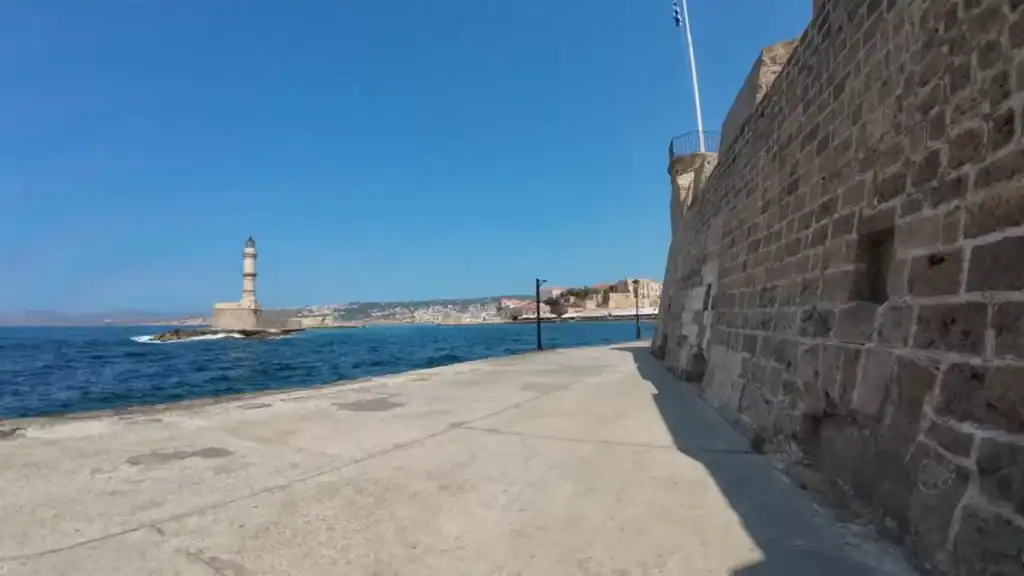
The lighthouse at the end of the harbour wall is Egyptian. That’s easy to forget when standing beside what appears to be a convincingly Venetian structure. The original breakwater and its fortifications date to the sixteenth century; the lighthouse was rebuilt by Egyptian forces during the nineteenth, during one of the island’s more complicated transitions of power.
The walk itself takes longer than expected. Follow the curving stone causeway around the outer edge of the harbour: past fishermen, past small wine shops inviting easy pauses, past uneven stone that makes unsuitable footwear a genuine problem. On a clear day, the view back toward the Venetian arsenals and waterfront skyline is extraordinary. In October, under a grey sky, the water darkens, the architecture feels more austere – less like a postcard, more like a place. What makes the harbour worth returning to isn’t any single sight but the way morning light, afternoon heat, and evening crowds produce genuinely different experiences of the same stones and water.
A sea turtle reportedly lives somewhere in the harbour, surfacing most reliably around eight in the evening, drawn by restaurant scraps. Whether this is charming or faintly absurd is a matter of perspective.
The Right Side of the Port (Which Fewer People Take)
On a food tour, a guide took her group to the right wing of the harbour – the Turkish side. It’s less visited. Many buildings are partially empty, some in protracted disrepair. The atmosphere is less polished than the left bank’s photogenic restaurants and more honestly complex: Ottoman minaret beside Venetian loggia beside a house that’s been repurposed three times in the past century. The left side offers a beautiful scene, a tourist-facing experience. Both exist simultaneously. But the right wing offers something the left generally doesn’t: the sensation of witnessing a place still deciding what it is.
Wine Not, and What a Good Deli Tells You About a City
Near the market sits a small wine bar and delicatessen called Wine Not – a name that signals self-awareness about its clientele. Ask the owner, and you might be offered a local rosé with a small tasting plate if a full platter feels like too much. What arrives: sliced cheese, mini dakos (Cretan barley rusks with tomato and olive oil), raisins still on a stem that look nothing like raisins, and a few olives. The wine is cooler than the afternoon outside. Places like this tell you more about how a city functions than landmark restaurants do. The fact that it exists – tucked between a pharmacy and a souvenir shop, neither prominently signed nor eager to be found – speaks to the density of good food culture in a small area.
The Activist Ruin and the Sunset Diversion
A building in the old quarter – occupied at one point by activists, still partially unreclaimed – offers sunset views into the Aegean. It’s not on standard routes. No one will tell you about it unless you know the unremarkable door matters as much as the Venetian lighthouse. The suggestion: bring something to drink and stay. Sunset from an unofficial rooftop terrace on a Greek island requires little further justification.
Synagogi, and the Particular Pleasure of Empty Bars
Synagogi sits in a former Venetian synagogue. The open-air bar is built around a ruined courtyard with alcoves, stone arches, and enough atmospheric improbability to seem invented. Visit in the late afternoon and it may be almost empty. The strange pleasure comes from occupying the stage before the performance begins – all potential, none of the noise. An espresso martini there is, apparently, worth mentioning by name.
Well of the Turk, and the Question of Boundaries
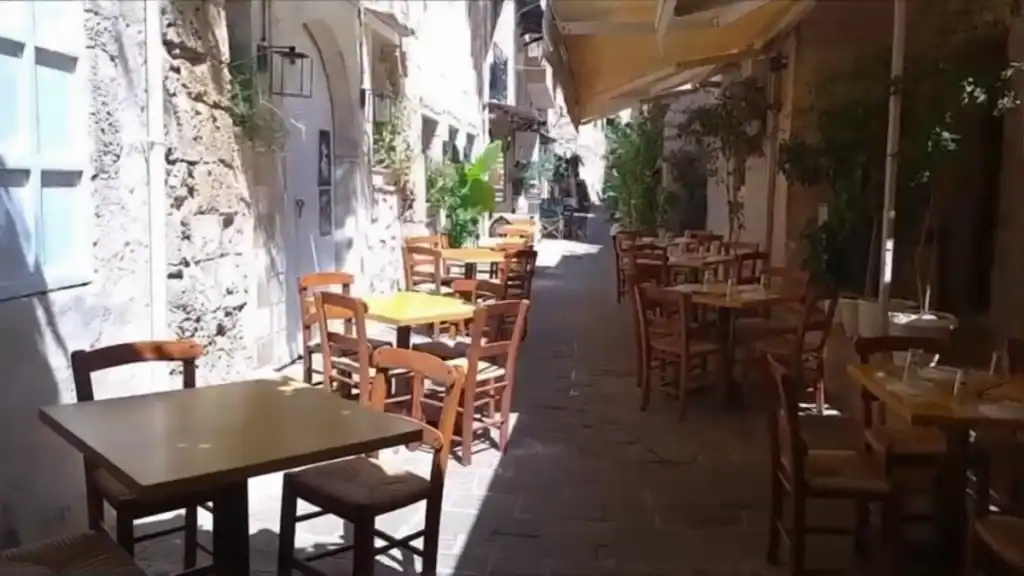
For dinner, the Well of the Turk occupies a quieter stretch of the old town – where ambient sound is footsteps rather than bar speakers. The menu straddles Greek and Turkish culinary traditions, reflecting real local history: vegetarian moussaka, spiced minced lamb on Turkish bread. Two glasses of wine and enough food for three came to eighty-five euros – reasonable, given quality and setting. The restaurant is good. The street it’s on is arguably better – proof that the best parts of Chania Old Town are not always the most Instagrammed.
Those who arrive solo in Chania often discover this stretch of old town not by plan but by following sound – an alley, a light, a doorway that suggests something is happening further in.
When to Visit
October brings grey skies and genuine quiet. The market has elbow room. The lighthouse walk is almost private. The food is exactly as good. September, by contrast, was described by a local guide as “absolutely mayhem” – the shoulder-season sweet spot everyone knows about, making it less of a sweet spot than it was. July and August are hot and busy, as expected. June is probably the honest answer for sun without density. April and May are worth investigating if you want the town rather than its performance.
Why the Corners Matter More Than the Highlights
The famous sights – the lighthouse, harbour, covered market – are genuinely beautiful and historically substantial. They are worth the time. But what stays with you, if you wander long enough, is less specific. It’s the sensation of a city where five centuries of layered occupation have been neither fully resolved nor neatly presented. Venetian archways lead to Turkish-influenced courtyards, lanes sell excellent local wine and cheese, afternoons accumulate twenty thousand steps without producing a complete itinerary. Chania Old Town resists tourism that wants everything legible. Streets that seem to go nowhere eventually go somewhere else. Bakeries run out of kalitsounia before you find them – the man behind the counter silently points toward Monday, when they’ll have more. Even the dead ends have a kind of direction.