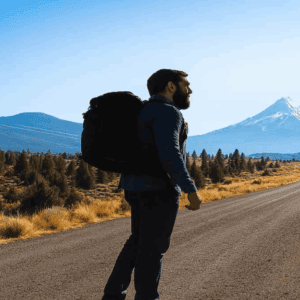

The name gives you something before you arrive. The Lefka Ori, the White Mountains, take their title from the old Greek for bare or uncovered. It is less a poetic flourish than a description. Vegetation thins quickly at altitude. Rock dominates. From the north coast near Chania the range rises abruptly, peaks exceeding two thousand metres, limestone flanks angled toward the Libyan Sea to the south. On clear spring days you can see snow resting along the ridges while the beaches below are warm enough for swimming. Whether that reads as contradiction or invitation depends on why you came to Crete.
Limestone and the Shape of the Land
Up close the mountains are not white. The stone shifts between pale grey and deep blue tones, darkening where moisture lingers. It is limestone throughout, lifted over millions of years as the African tectonic plate presses into the Eurasian. Crete is still rising. Earthquakes here are not historical detail. They are ongoing geology.
The pressure that forced the land upward also carved it. Around one hundred gorges cut through Crete, with a dense concentration in the Sfakia region south of Chania. From the ferry between Hora Sfakion and Sougia you can see several of them etched into the massif, parallel incisions draining the same block of stone. The Samaria Gorge is the most famous – sixteen kilometres of descent through limestone walls that press to three metres apart at the Iron Gates – and remains the most dramatic single-day walk this mountain range offers. The Aradena and Eligias gorges are less trafficked and feel different in scale and tone. None of them repeat themselves.
Above the gorge rims the terrain changes character. Loose scree. Jagged rock that wears through boot soles faster than seems reasonable. Distance measured in hours rather than kilometres. A fall is not dramatic but consequential. The landscape does not exaggerate its difficulty. It simply maintains it.
Middle Altitude and the Plateau Villages
Before the exposed ridges there is a middle zone that most visitors never reach. Around Anopoli the plateau holds olive trees, wild herbs, and shepherd paths that predate modern mapping. In early May yellow daisies spread beneath the groves. Cypress trees twist out of thin soil, some of them centuries old, their growth measured in restraint rather than height. Beehives sit in clusters, painted blue, stacked on tyres, positioned carefully for shade. As flowering shifts with altitude, beekeepers move the hives uphill to follow it. The honey changes with elevation and season, thyme and pine adjusting their proportions. Buying it here, rather than at the airport, alters nothing except the memory attached to it.
Ruins surface gradually. Terraces that once held cereal crops. Collapsed dwellings. Stone walls marking fields that are no longer cultivated. This region supported a far larger population in previous centuries. Today villages such as Anopoli, Aradena, and Argoules are small, partly seasonal, partly self sustaining.
Aradena carries a particular history. Dating back at least to the sixteenth century, it once minted its own coinage. Its decline was not caused by invasion but by a vendetta in 1948 between two families, sparked by a dispute over a goat bell. The violence that followed emptied much of the settlement. The Bailey bridge that now spans the Aradena Gorge was installed during the Second World War. When vehicles cross, the wooden deck produces a deep rumble. Attempts to quiet it were resisted by locals who preferred the audible signal of arrival. The sound remains. In summer, bungee jumping operates from that bridge. The juxtaposition of military engineering and seasonal recreation feels neither entirely absurd nor entirely seamless.
Higher Ground and What It Requires
Pachnes, at 2,453 metres, is the highest summit in the range. Zaranokefala, at 2,139 metres, offers a more manageable objective for a strong day walk. From near Anopoli an old shepherd path climbs through a narrow valley to a col in roughly ninety minutes. From there, another hour leads to the summit in clear conditions. Three to four hours return at a steady pace is reasonable. The route is marked by cairns but not engineered. A spring at a key junction provides water in most seasons, a practical detail rather than a footnote.
Views from the top extend across the Samaria Gorge, the Aradena chasm, and on clear days toward Frangokastello on the south coast. Pachnes demands more. Snow can block the upper access track well into May. Wind at the summit is not decorative. Gusts strong enough to force you sideways are possible even in late spring. A small stone shelter sits near the top, functional rather than symbolic. It exists because exposure here is real. Going unprepared is not adventurous. It is simply ill considered.
Season and Access
Snow typically closes high routes from December through April, sometimes longer. Drifts can remain metres deep near Pachnes while olive trees below are already in leaf. In summer the difficulty reverses. Coastal approaches to gorges become heat traps by mid morning. The walk from Agia Roumeli to the entrance of Eligias Gorge takes around forty five minutes along open beach. In July that distance requires early starts and deliberate pacing.
Late April to early June and September through October tend to offer the most stable conditions. Flowers bloom. Birdlife is active. Temperatures are workable. Even then, the mountain determines the day more than the forecast does.
Cave systems respond to the same seasonal rhythm. Draka Lari, an underground river system on the southern slopes, can be partially flooded by snowmelt in spring. Access shortens. The sound deeper inside alternates between rushing water and air moving through unseen chambers. What the mountain reveals depends on timing.
Scale and Orientation
A smaller summit such as Papakefala provides orientation without full commitment to the higher ridges. From there you can see Agia Roumeli at the mouth of the Samaria Gorge, the dark incision of Eligias meeting the sea, and ferries tracing white lines across deep blue water. The view clarifies how the gorges relate to one another. They are not isolated features but part of a connected drainage system carved through the same limestone mass.
Old paths reappear and disappear according to use. Some were reopened by locals in recent decades after years of overgrowth. Their routing follows the land’s logic rather than efficiency. Forks occur without signage. Sheep tracks diverge into scree. A map is necessary, and so is attention. Boots matter here more than almost anywhere else on the island. The rock is abrasive. Ankles are tested. Springs are reliable but spaced according to terrain rather than convenience. Carrying sufficient water requires planning.
Solo walkers in good condition can manage the mid altitude routes and many gorge approaches. Higher summits demand an honest assessment of weather, fitness, and time. The shelter on Pachnes is not ornamental.
Below, on the south coast, stands Frangokastello, built by the Venetians in the fourteenth century to impose control over the Sfakia region. Control was partial at best. The mountains absorbed outside forces and remained, at altitude, resistant to easy governance. That quality persists in subtler ways. The landscape is not arranged for comfort. What it offers instead is scale. Silence that does not need embellishment. A terrain that feels geologically present.
On clear days from Zaranokefala the coastline lies visible between mountain and sea, a reminder that the beaches and the peaks belong to the same island – and that Chania, sitting at the edge of both, is a better base for exploring either than it might first appear. Three and a half hours to a summit. Longer if the wind decides otherwise.