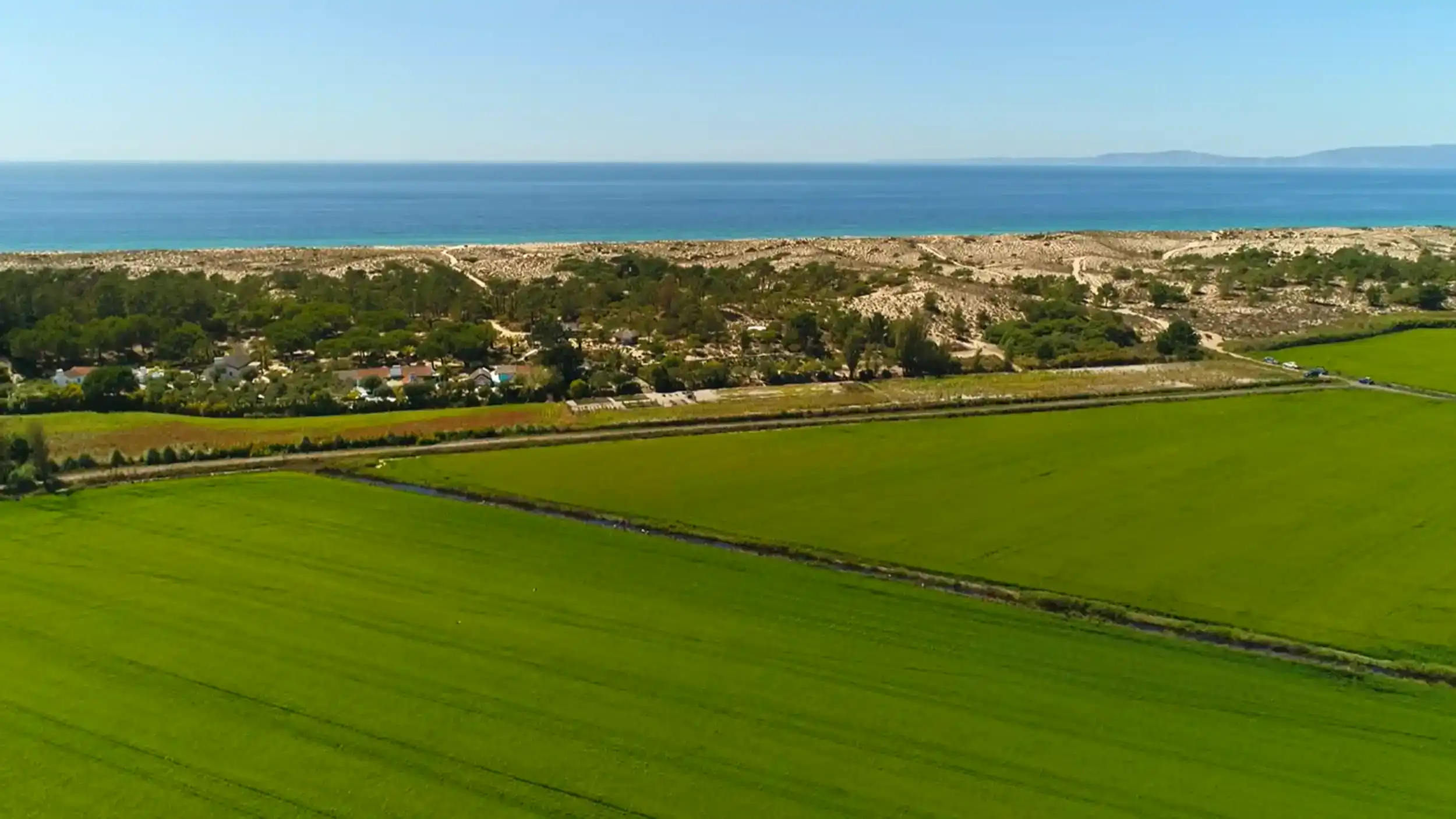
The Comporta rice fields are far more than a scenic backdrop to the village. They form a vast working landscape that changes dramatically throughout the year, with flooded paddies, vivid green crops and golden harvests creating completely different impressions from one season to the next.
For many visitors, the Comporta rice fields become one of the defining memories of the region, not because they are designed for tourism, but because they reveal how closely the area’s identity remains connected to agriculture and the surrounding natural environment.
🌾 What the Rice Fields Actually Are
The Comporta rice fields are a working agricultural landscape, not a decorative feature created for visitors. Rice has been grown here for more than a century, and the fields continue to operate as part of the Herdade da Comporta estate, with farming shaping both the scenery and the rhythm of the seasons.
The Estate Behind the Comporta Rice Fields
The scale of the landscape often surprises first-time visitors.
| Feature | What it means |
|---|---|
| 🌾 Working rice paddies | Farmed for agricultural production |
| 💧 Irrigation channels | Control water levels throughout the growing season |
| 🌲 Pine forests | Form the western edge of the estate |
| 🏡 Small settlements | Villages sit around, rather than within, the fields |
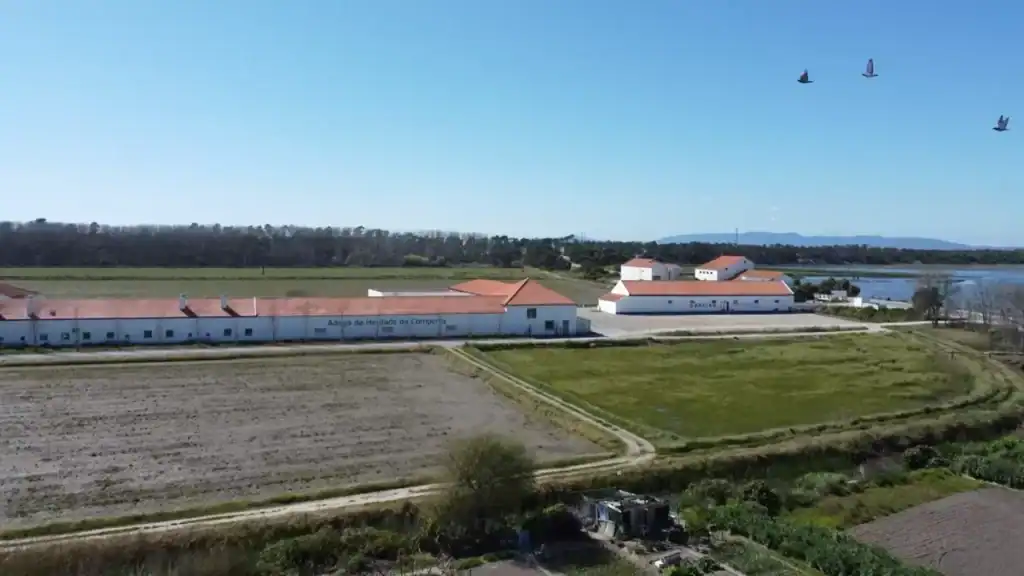
The estate covers around 12,500 hectares between the Sado Estuary and the Atlantic dunes, with the rice paddies occupying much of its flat interior. Although Comporta village is the best-known destination, it represents only a small part of a much larger landscape that also includes Carrasqueira, Carvalhal and several other settlements.
A Landscape That Has Stayed Intact
Unlike many coastal regions, the Comporta rice fields have remained remarkably coherent because the estate has continued to be managed as a single landscape rather than being divided into smaller developments.
That sense of continuity helps explain why driving through the fields feels so distinctive. Visitors wanting to understand how the surrounding villages fit into the wider area may also enjoy Comporta Village, which explores the settlement that sits on the edge of this remarkable agricultural landscape.
🔄 How the Fields Change Through the Year
The Comporta rice fields never look the same for long. Instead of changing gradually with the seasons, they transform through the stages of the farming cycle, creating landscapes that can appear almost unrecognisable from one visit to the next.
Spring: Flooded Comporta Rice Fields
Spring brings one of the most photogenic phases of the year.
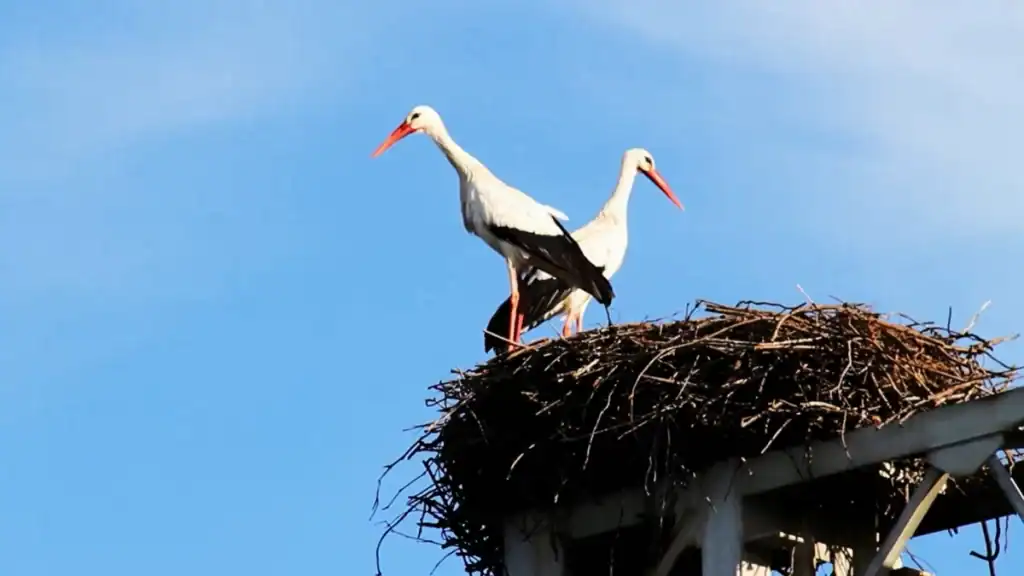
The paddies are flooded in preparation for planting, turning the landscape into a network of shallow mirrors that reflect the sky, clouds and surrounding trees. It’s also when white storks become especially noticeable, feeding in the newly flooded fields and adding to the sense that nature and agriculture work together here.
Summer and Autumn: From Green to Gold
As the young rice plants establish themselves, the flooded reflections gradually disappear beneath dense green growth. By late summer, the Comporta rice fields have become a continuous carpet of colour stretching towards the horizon.
During September and October, the crop ripens into rich shades of gold and amber before harvest begins. This is often considered the most dramatic time to visit, as changing light and gentle winds create constantly shifting patterns across the fields. Travellers visiting nearby Carrasqueira Palafitic Pier will notice the same seasonal colours extending across the estuary landscape, linking two of the area’s most distinctive attractions.
After the Harvest
Once harvesting is complete, the fields become quieter and more understated.
Cut stubble replaces the golden crop, irrigation channels become easier to see and the underlying structure of the estate is revealed once again. Although fewer people visit at this time of year, it offers one of the clearest views of the agricultural landscape that defines the Comporta rice fields.
🚴 Exploring the Fields: Cycling, Walking and What to Look For
The best way to experience the Comporta rice fields is to slow down.
Cycling allows you to cover far more of the estate than walking, while still giving you the freedom to stop whenever the landscape changes. Quiet roads, almost level terrain and minimal traffic make this one of the easiest places in Portugal to explore by bike.
Exploring the Comporta Rice Fields by Bike
Each way of exploring offers a slightly different perspective.
| Option | What to expect |
|---|---|
| 🚴 Cycling | Covers large areas with little effort |
| 🚶 Walking | Best for short sections in cooler parts of the day |
| 🚗 Driving | Easy access to viewpoints along the roads |
| 📸 Frequent stops | Ideal for birdlife and changing scenery |
Walking is equally rewarding but works best early in the morning or towards evening, particularly during the warmer months when there is very little shade across the exposed paddies. The flat landscape makes distances appear shorter than they really are, so even modest walks can take longer than expected.
Wildlife Along the Way
The Comporta rice fields support an impressive variety of wildlife throughout the year.
White storks are the most familiar sight, often feeding beside irrigation channels or nesting high on utility poles overlooking the paddies. As the fields approach the eastern edge of the estate, the landscape gradually merges into the Sado Estuary, where Sado Estuary dolphins and hundreds of bird species highlight the importance of this protected natural environment.
📸 Photography: When to Go and Where to Stand
Light transforms the Comporta rice fields as much as the seasons do. The open landscape creates long sightlines with very few obstructions, allowing reflections, colour and changing weather to become part of every composition rather than simply a backdrop.
Best Light for the Comporta Rice Fields
Different times of day produce very different results.
| Time | Best for |
|---|---|
| 🌅 Early morning | Soft light, calm reflections and active birdlife |
| ☀️ Midday | Crisp detail and vibrant colours |
| 🌇 Late afternoon | Warm tones across ripening rice |
| ☁️ Overcast days | Rich autumn colours with reduced contrast |
Spring is ideal if you want mirror-like reflections across flooded paddies, while September and October provide the richest colours as the crop turns from green to gold. Even slight changes in wind can dramatically alter reflections, making calm mornings particularly rewarding for photographers.
Finding the Best Viewpoints
Some of the strongest photographs require very little walking.
Many of the estate roads run at the same level as the paddies, allowing low-angle views directly across the crop from safe roadside positions. If you’re continuing your journey afterwards, Lisbon to Comporta highlights how these landscapes begin appearing well before the village itself, making the drive part of the photographic experience rather than simply the journey there.
📝 Practical Notes
The Comporta rice fields are easy to explore, but they remain a working agricultural landscape. Roads are public, yet many tracks lead to private farmland, so it’s best to stay on marked routes and avoid entering the paddies themselves.
Visiting the Comporta Rice Fields
A little planning helps you make the most of your visit.
| Practical tip | Why it matters |
|---|---|
| 🚗 Travel by car or bicycle | The fields cover a large area |
| 🌅 Visit early or late | Cooler temperatures and better light |
| 👟 Stay on public roads | The estate remains an active farm |
| 📅 September and October | Often the most visually dramatic season |
The rice-growing cycle means every visit offers something different. Spring brings reflective flooded paddies, summer delivers vivid green landscapes and early autumn transforms the Comporta rice fields into shades of gold before harvest begins.
If this is your first visit to the area, Lisbon to Comporta explains how the landscape gradually changes as you approach, helping you appreciate why the rice fields feel like such a distinctive gateway to this part of the Alentejo coast.