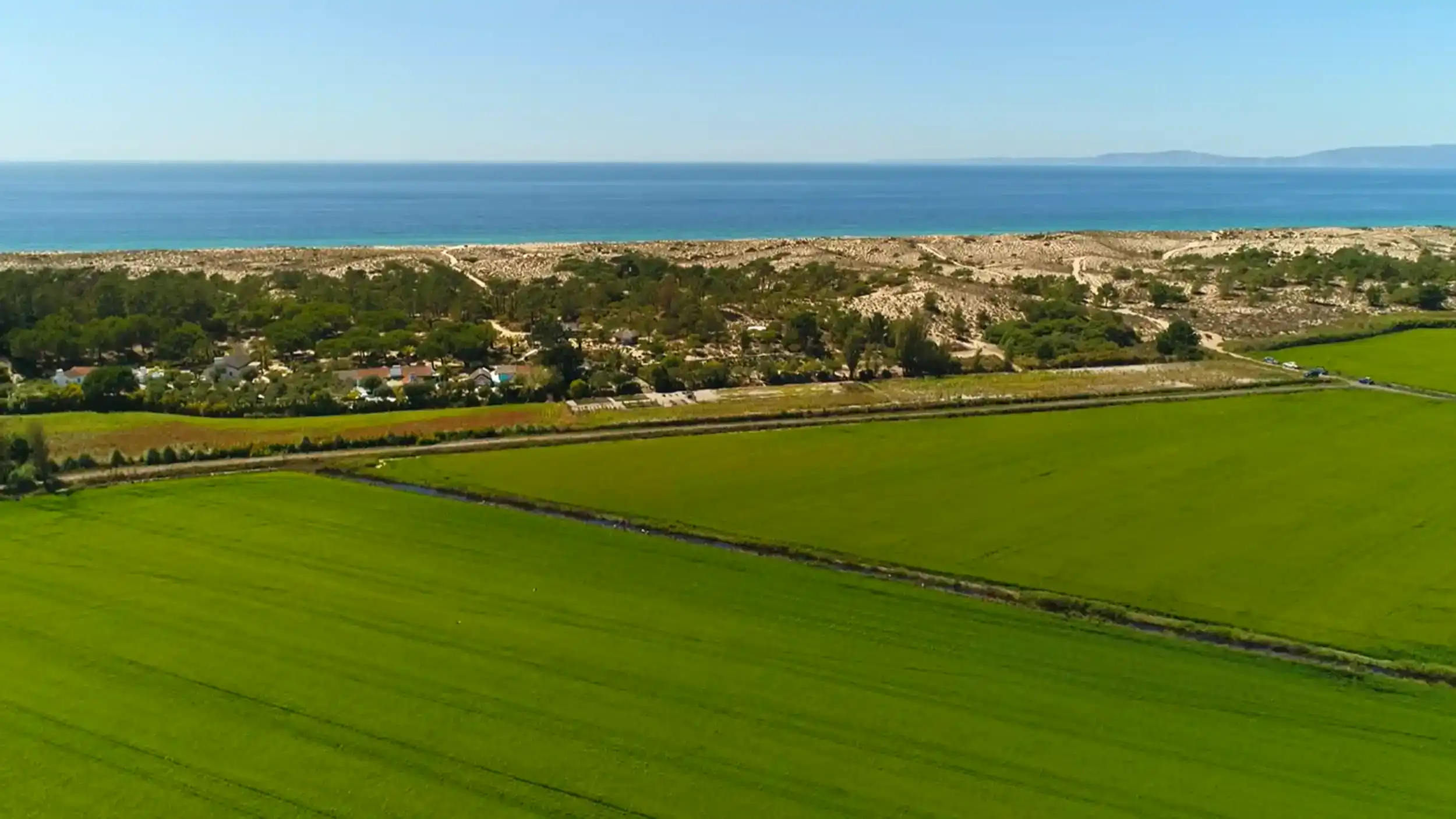
I had expected the Comporta rice fields to be attractive scenery on the way to the coast. What I had not expected was how quickly they would change my sense of the place. Once I was out among the paddies, irrigation channels and long flat horizons, Comporta felt less like a polished beach destination and more like a working landscape that happened to be beautiful.
That distinction mattered to me. The fields were not arranged for visitors, and I never felt as though I was moving through a manufactured attraction. Their appearance depended on farming: reflective water at one stage, dense green rice at another, then gold before harvest. I came away thinking that anyone who only sees Comporta village and the beach misses a large part of what gives the area its character.
🌾 Are the Comporta Rice Fields Still a Working Landscape?
I understood the fields differently once I stopped looking at them as a backdrop. Rice has been grown here for more than a century, and farming on the Herdade da Comporta estate still determines both the scenery and the rhythm of the seasons. That explained something I had noticed almost immediately: the landscape felt purposeful rather than ornamental.
The Scale Only Became Obvious Once I Crossed the Estate
Photographs had given me completely the wrong impression of scale. I had pictured individual fields around Comporta. Driving across the estate, I realised I was looking at a much bigger agricultural system.
| Feature | What it means |
|---|---|
| 🌾 Working rice paddies | Farmed for agricultural production |
| 💧 Irrigation channels | Control water levels throughout the growing season |
| 🌲 Pine forests | Form the western edge of the estate |
| 🏡 Small settlements | Villages sit around, rather than within, the fields |
The estate covers around 12,500 hectares between the Sado Estuary and the Atlantic dunes. That number sounded abstract until I had spent time crossing it. Comporta village suddenly seemed like one small piece of a landscape that also includes Carrasqueira, Carvalhal and other settlements, rather than the centre of everything.
The Unbroken Farmland Was What Made It Feel Different
I kept noticing how long I could travel without the landscape dissolving into the kind of scattered development I associate with many popular coastal areas. The rice fields remain part of one much larger managed estate, and that continuity gives the journey through them a sense of space I had not expected so close to fashionable Comporta.
It also changed my view of Comporta Village. I liked the village, but I would not judge the area from the settlement alone. The farmland around it was what made the village’s setting make sense to me.
🔄 How Much Do the Rice Fields Change With the Seasons?
One thing I had underestimated before the trip was how temporary any single view of the paddies really is. The farming cycle moves them from water to green growth and then towards harvest colours, so the version of Comporta I saw was only one stage in a repeating sequence.
Flooded Paddies Can Turn Spring Into a Mirror
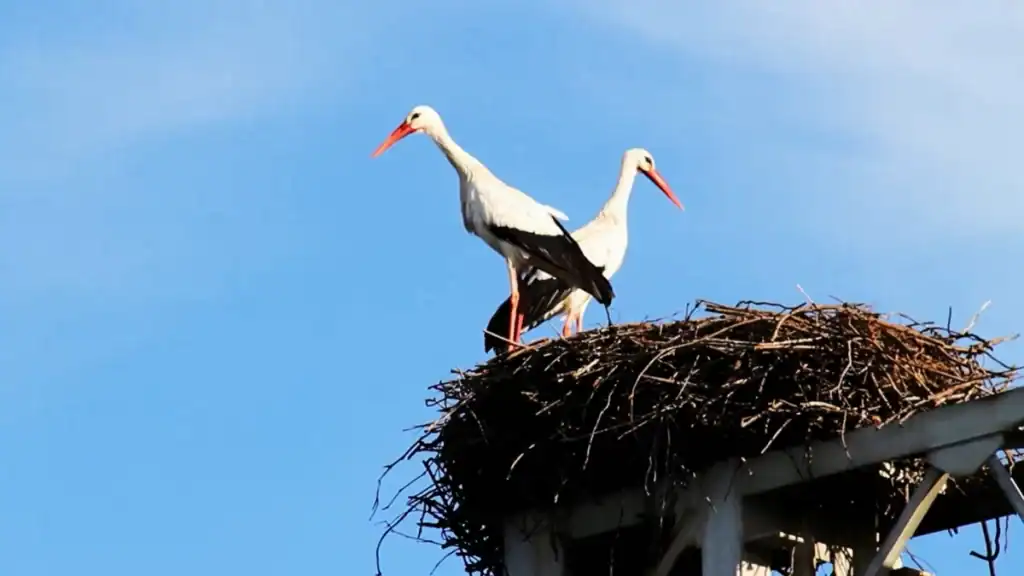
If I were choosing specifically for reflections, I would come in spring. When the paddies are flooded for planting, shallow water opens up across the flat land and catches the sky, clouds and trees. Seeing white storks feeding around the wet fields made the connection between agriculture and wildlife much more tangible than I had expected.
Green Rice Gives Way to Gold Before Harvest
As the crop establishes itself, those reflections gradually disappear beneath dense green growth. By late summer, water is no longer the main visual draw. It is the colour, stretching so far across the flat ground that small changes in wind and light become surprisingly noticeable.
September and October would tempt me back for a different version of the same landscape. The rice turns through gold and amber before harvest, and the fields begin to look warmer and softer. Similar seasonal colours continue towards nearby Carrasqueira Palafitic Pier, which made two very different stops feel visually connected rather than separate attractions.
After Harvest, the Structure Becomes Easier to Read
I would not choose the post-harvest period if my only aim were dramatic photographs. Cut stubble is quieter than flooded water or ripening rice. But stripping away the colour exposes the irrigation channels and the underlying layout, and I found that useful because it makes the mechanics of the landscape easier to understand.
For someone more interested in how Comporta works than in collecting its prettiest view, that less glamorous stage could actually be the more revealing one.
🚗 How Do You Get to the Comporta Rice Fields?
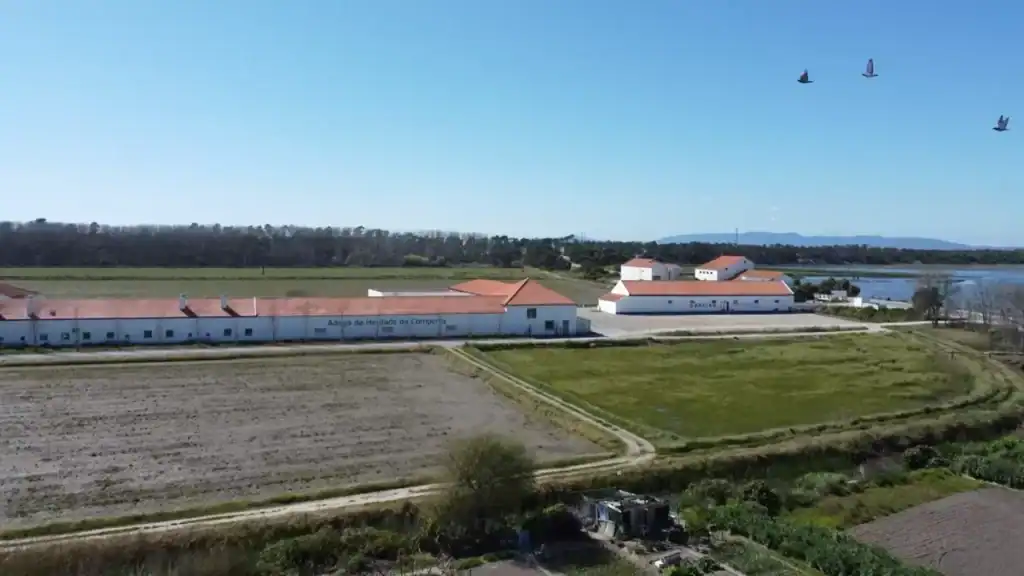
I had imagined there would be a single rice-field entrance or viewpoint to aim for. There isn’t. The paddies spread around Comporta and towards Carrasqueira, so I found it more useful to think of them as a landscape you enter rather than an attraction you arrive at.
The simplest starting point is Comporta itself. From the village, roads towards Carrasqueira take you alongside and through the wider rice-growing landscape, with views opening up from the public roads. If I were arriving specifically to cycle, I would start around Comporta rather than trying to locate a separate “rice fields” pin.
That also makes the approach from Lisbon straightforward. Our Lisbon to Comporta route brings you into the same landscape, and the paddies begin to appear before the village. I found that gradual arrival more useful than hunting for one designated viewpoint because it showed me how extensive the fields actually are.
🚴 What Is the Best Way to Explore the Rice Fields?
I enjoyed the fields more once I stopped treating them as scenery between destinations. Driving was useful for understanding their scale, but it also encouraged me to keep moving past details I wanted to look at properly. That was the point at which cycling started to make more sense to me.
A bicycle gives enough range to cover a substantial part of the estate without losing the freedom to stop when a stork, reflection or change in the fields catches your attention. The quiet roads, almost level terrain and relatively light traffic all reinforced that judgement. I would choose cycling if the fields themselves were one of the reasons for my visit rather than just something I happened to pass.
How Long Does It Take to Cycle Around the Rice Fields?
I would allow roughly two hours if I wanted a meaningful ride through the rice-field landscape rather than a quick spin from the village. There is no single official circuit around all of the paddies, so the answer depends on the route you choose. A useful benchmark is Comporta to Carrasqueira and back through the rice fields: published cycling routes in this area are around 22–26 km and typically take a little over two hours of riding.
That matched the way I would plan it after seeing the terrain. I would give myself closer to two and a half or three hours if I wanted to stop for photographs, watch the storks or include the Carrasqueira Palafitic Pier rather than treating the ride as exercise. A shorter outing is easy to improvise, but I would not describe “cycling around the rice fields” as one fixed loop with one fixed duration.
Walking and Driving Still Have Their Place
I would not use the same method for every part of the day. Each one solved a different problem.
🚴 Cycling
I would choose this for covering a larger area without giving up the freedom to stop.
🚶 Walking
I would keep this to shorter stretches, particularly during the cooler parts of the day.
🚗 Driving
This worked best for linking villages and reaching viewpoints spread across the wider estate.
Walking exposed one piece of friction I had not really considered beforehand: there is very little shade across the paddies. The flat horizon was deceptive too. I repeatedly looked at something in the distance and assumed it was closer than it was. In warmer weather, that is enough for me to favour early or late walks rather than setting off across a long stretch in the middle of the day.
White Storks Kept Giving Me Reasons to Stop
The storks were what most often broke my momentum. They were easy to spot feeding beside irrigation channels or nesting high above the paddies, and I began looking for them almost automatically rather than treating wildlife as a separate activity.
Towards the eastern edge, the fields merge into the Sado Estuary. That transition helped me see the paddies as part of a wider environment rather than an isolated agricultural scene. Our guide to Sado Estuary dolphins explores another part of that protected landscape.
📸 When Do the Rice Fields Look Best for Photography?
I had assumed the season would matter more than the hour. Once I was there, light proved almost as important. With so little interrupting the horizon, a reflection, a patch of cloud or a change in wind could alter the whole scene rather than merely changing the background.
Calm Spring Mornings Give Reflections Their Best Chance
For the mirror-like images I had in mind before visiting, I would now pair spring flooding with an early, calm morning rather than simply turning up whenever convenient.
| Time | Best for |
|---|---|
| 🌅 Early morning | Soft light, calm reflections and active birdlife |
| ☀️ Midday | Crisp detail and vibrant colours |
| 🌇 Late afternoon | Warm tones across ripening rice |
| ☁️ Overcast days | Rich autumn colours with reduced contrast |
For colour rather than reflections, September and October would be my choice. The rice moves from green towards gold, and lower light can warm it further. I also noticed how little wind it took to disturb the surface of the water. That was useful friction: the reflective photographs that look effortless depend on conditions being much calmer than a still image suggests.
Some of My Favourite Views Needed Almost No Walking
I had expected the better views to require seeking out special viewpoints. In practice, several came from ordinary estate roads running level with the paddies. Pulling over safely and looking low across the crop often gave me more of the scale than trying to find somewhere elevated.
That is also why I would not rush the approach. Our Lisbon to Comporta route shows how the landscape begins appearing before the village. I had thought of that stretch as travel time; by the end of the trip, I regarded it as part of the experience.
📝 What Should You Know Before Exploring the Rice Fields?
The fields were straightforward to explore, but I never forgot that I was moving through active farmland rather than an open-air attraction. Staying on public roads and marked routes was the simplest choice, and it meant I could explore without treating private paddies as though they existed for visitors.
A Few Choices Made the Visit Easier
The main decisions were practical ones I could make before setting off: how much ground I wanted to cover, how hot the day was likely to become and whether I cared more about seeing a lot or stopping often.
👟 BEFORE YOU EXPLORE
- I would use a car or bicycle if I wanted to cover a substantial area.
- I would keep walking to early or late in warmer weather because the lack of shade becomes noticeable quickly.
- I would stay on public roads and marked routes. These are working fields, not visitor paths.
I would also choose the timing of a return visit according to the landscape I wanted to see. Spring would be about water and reflections, summer about saturated green, and early autumn about the crop turning gold before harvest. I would not tell someone there is one universally “best” season because those are genuinely different experiences.
For a first visit, I would still approach via our Lisbon to Comporta route rather than treating the rice fields as a separate stop to tick off. Watching the paddies gradually take over the view was how the scale of Comporta first registered with me. That slow reveal did more than any single viewpoint to explain why this working landscape became one of the parts of the area I remembered most clearly.