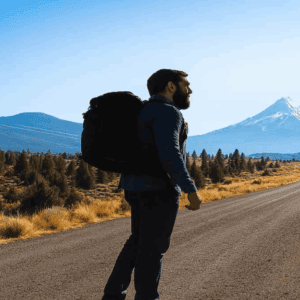

The road drops gradually toward Ragusa, though it does not feel like an arrival in the usual sense. Limestone hills open and close around the road, pale and brittle looking in the dry light, and the land has the worn quality of somewhere that has been cultivated and contested for a very long time. Nothing here feels accidental. Even before the city appears, the terrain suggests a history of argument.
When Ragusa finally comes into view, the geography explains something immediately. The city is split. Not metaphorically or administratively but physically, across a deep limestone ravine. What visitors often describe as one place is in fact two: Ragusa Superiore above and Ragusa Ibla below. They were formally unified in 1927, yet the separation remains visible in the slopes, in the staircases, in the way daily life distributes itself across elevation.
The division began after the earthquake of January 1693, which devastated much of southeastern Sicily, collapsing entire towns across the Val di Noto. Ragusa was among them. When rebuilding began, the aristocracy proposed moving uphill to a more orderly site where a new city could be laid out with wider streets and a sense of modernity appropriate to the eighteenth century. The residents of the older quarter had other ideas. They stayed where they were, rebuilding on the original site among the narrow streets and terraces that had defined the town before the earthquake.
What followed was not a simple rebuilding but a quiet divergence. The old settlement below became Ragusa Ibla, rebuilt largely in the ornate Baroque style that spread across the region after the disaster. The newer upper city developed separately on the plateau above. The two remained administratively distinct for centuries before the Italian state decided they should be treated as one municipality.
Ragusa Superiore spent much of its early life feeling incomplete, as though it had been planned faster than it could grow. Its streets were broader, its buildings more regular, but the cultural weight remained in the older town below. For a long time the upper city seemed to exist slightly in the shadow of Ibla.
Then television intervened. The fictional detective Inspector Montalbano, whose cases unfold across the landscapes of southeastern Sicily, brought cameras and production crews into the area. Scenes filmed around Ragusa and its neighboring towns placed familiar piazzas and staircases on screens across Italy. The effect was gradual rather than explosive, but noticeable. Visitors began arriving with a vague recognition of the architecture. Tourism often works that way, quietly altering the rhythm of places long after the buildings themselves were constructed.
Ibla, on Foot
Entering Ragusa Ibla requires a willingness to climb. The staircases that lead upward through the old quarter are steep enough to make themselves known after a few minutes. The effort shapes the experience of the town. Movement here is vertical as much as horizontal, and the reward for climbing is usually a view that reveals another layer of stone terraces descending toward the ravine.
Inside one of the churches along the climb, the atmosphere shifts abruptly. The exterior promises theatrical Baroque excess, yet the interior feels quieter than expected, the light subdued. The building dates to the eighteenth century but did not begin with the brightness it has now. The dome and stained glass that illuminate the nave were added later during renovations. Structural pillars, visible today along the interior, were introduced after earthquake damage to stabilize the building. Even centuries later the memory of seismic risk remains embedded in the architecture.
Nearby, the church of San Giorgio rises above its piazza with the curved façade typical of Sicilian Baroque. The building appears almost to lean into the space in front of it, drawing attention toward the entrance. Baroque architecture across the Val di Noto often carries this sense of deliberate drama. These were not modest reconstruction projects. After the destruction of 1693, cities across the region rebuilt themselves with a visible insistence on beauty and presence.
A short walk away stands a quieter building with a different kind of story attached to it. The Conversation Club was founded in the early nineteenth century by a group of local landowners who gathered to discuss provincial affairs. Membership was restricted and the meetings were exclusively male. The institution has survived long enough to adapt, though not quickly. Today it has a female president, a small but telling evolution for a club that once defined itself through exclusion.
Civic buildings in Ibla sit close together in a way that suggests how seriously the town regarded its own institutions. The Palazzo Comunale stands near the church of San Giuseppe, both dating to the nineteenth century and occupying a central space in the town’s layout. Around them, older structures survived the earthquake that destroyed so much else. Their facades still carry sundials, the stone surfaces worn into a soft texture that comes only from time and weather.
Occasionally the architecture becomes inventive out of necessity. In one narrow street a covered passageway stretches between two buildings, creating what locals sometimes call a living bridge. It is less a bridge in the formal sense than a practical solution, a way of reclaiming space above an alley where there was nowhere left to build outward. In towns constrained by topography, ingenuity often appears in these small structural improvisations.
At the eastern edge of Ragusa Ibla, the streets loosen slightly as they approach the Giardino Ibleo. The garden is regarded as one of the oldest public parks in Sicily, though nothing about it feels ceremonial. Paths wander between carob trees, pomegranate shrubs, and a few mulberries. Benches sit under patches of shade. By late afternoon the light moves slowly through the branches, turning the gravel paths pale gold.
The carob trees are easy to overlook unless someone points them out. Locally the plant’s name traces back to the Arabic word karuba, a reminder of the centuries when Arab rule shaped agriculture across the island. Before sugar became widely available, carob served as a sweetener. During periods of scarcity it replaced cocoa. Its seeds, which are remarkably consistent in weight, became the historical standard used to measure gemstones. The word carat comes from carob. Standing beneath the branches in the garden, the connection between the tree and that distant measurement system seems unexpectedly plausible.
What Gets Eaten Here
Food in the province of Ragusa carries a certain seriousness, though it rarely presents itself with ceremony. The landscape that surrounds the city has shaped its cooking for centuries, particularly through dairy production. The most prominent example is Ragusano DOP, a stretched curd cheese produced locally and aged in large rectangular forms. As it matures the flavor sharpens slightly, developing a firm texture and a faint spice that makes it difficult to mistake for anything else.
Bread appears in a form known as scacce, a folded flatbread that resembles focaccia but behaves more like practical street food. The dough is layered around fillings that often include tomato and cheese, sometimes olives or onion. The structure makes it portable. It is the kind of food eaten while walking between one part of town and another, the chew of the bread substantial enough to feel deliberate.
Carob returns in the region’s desserts. Ground into powder, it finds its way into biscuits and sweets where its flavor sits somewhere between cocoa and something earthier. The taste hints at the agricultural history of the surrounding countryside, where rocky soil and dry heat have supported crops that are both stubborn and well adapted.
Olive oil is another local point of attention. The DOP designation that covers this region includes several Sicilian provinces, but oils produced around Ragusa often carry a distinctive character. The altitude of the groves, the dryness of the climate, and the age of many trees contribute to an oil that can feel direct and assertive on the palate. When it is tasted locally, the method is simple. Bread is torn rather than sliced, the oil poured into a small dish rather than carefully drizzled. Precision is not the goal. Contact is.
A Province That Is Rethinking Itself
Ragusa’s role as a provincial capital dates to 1927, the same administrative decision that unified the upper and lower cities into a single municipality. Provincial status brought government offices and a degree of economic stability, giving the city reasons to retain residents who might otherwise have left. Even so, the broader region remains the youngest province in Sicily, a distinction that carries both limitations and possibilities.
Like much of southern Europe, Sicily has spent decades watching many of its educated young people depart. University graduates often move north or leave the country entirely in search of opportunities unavailable on the island. The pattern has become familiar enough to feel almost structural.
Professor Rosario Ferrachi of the University of Catania has spent years examining whether that pattern can be altered. His argument begins not with sentiment but with infrastructure. Sicily already possesses elements that could support a different economic trajectory: a substantial agricultural base, emerging technology sectors, and a population that has been trained in fields ranging from engineering to digital services.
The question, in his view, is whether conditions can be built that make returning worthwhile. Investment in education, improved transport links, and broader international attention could create an environment where young professionals see the island not as somewhere to leave but somewhere to build.
Small signs of that shift appear occasionally. Startups in agricultural technology and digital services have begun to appear in parts of the region, suggesting that innovation here does not have to mean abandoning traditional industries. Agriculture and technology are not opposites if the infrastructure exists to connect them.
Whether this transformation will accelerate remains uncertain. Ragusa Ibla, once in danger of gradual abandonment, has regained economic life through tourism and the growing recognition of its architectural heritage. Ragusa Superiore continues to develop an identity of its own after centuries spent as the quieter counterpart above the ravine.
Late in the day the Giardino Ibleo grows quieter. The shadows of the carob trees stretch across the paths, and the benches begin to fill with people who are not particularly interested in architecture or economic theory. The garden has been open to the public since the nineteenth century. It still offers the same modest things it always did: a place to sit, shade from the sun, the slow presence of trees that have been here longer than most of the city around them. Some parts of a place remain uncomplicated. Ragusa, despite its long arguments with itself, has managed to keep a few of those intact.